

Assessing Climate Finance Quality in Practice: Lessons from Six Cases
Assessing the quality of climate finance is a complex, frontier topic further complicated by a lack of comprehensive, consistent data. CPI’s work on climate finance quality to date has provided a holistic, theoretical framework for understanding the quality of public climate finance, followed by an exploration of the existing indicator base that could be harnessed for assessments of quality at the project, market, and system levels, respectively. More recently, a practical assessment tool was developed to assess the quality of adaptation finance specifically (CPI, 2026). The premise of the work to date has been the need to converge on a common understanding of climate finance quality across the many active public climate finance providers. Moving toward implementation in practice also exposes a lack of comprehensive and consistent data, required for aggregate assessments of climate finance quality across (public) actors, sectors, and geographies.
This paper takes a case-study approach to analyze real-world public climate finance interventions, yielding insights into the question: What constitutes high-quality public climate finance? Spotlighting six cases of public climate finance deemed to have transformational potential that span different financing approaches, this paper facilitates deeper and more nuanced discussion of the 10 dimensions of transformational public climate finance synthesized by CPI. It allows analysis of the design and delivery dimensions that contribute to high-quality public climate finance. In doing so, the paper distills lessons and implications for assessing and subsequently improving the quality of public climate finance. It is intended to inform public climate finance providers seeking to improve the quality of their interventions, as well as the broader climate finance community seeking to converge on a common understanding of climate finance quality.
Analyzing a sample of public climate finance interventions facilitate aggregate learnings, including, importantly, insights into where trade-offs may arise. As discussed in CPI’s initial scoping study, climate finance quality can mean a range of things, depending on whom you ask. Concurrently, CPI’s 10 dimensions for assessing the transformational potential of public climate finance (see Figure 1) cut across a range of considerations for public climate finance providers when designing and delivering interventions. A single intervention cannot be expected to satisfy every dimension simultaneously, and trade-offs will inevitably occur. By analyzing a sample of public climate finance interventions deemed to have transformational potential, this paper derives insights into where those trade-offs and limitations arise, in turn allowing for a more nuanced discussion of what constitutes climate finance quality and how to assess it.
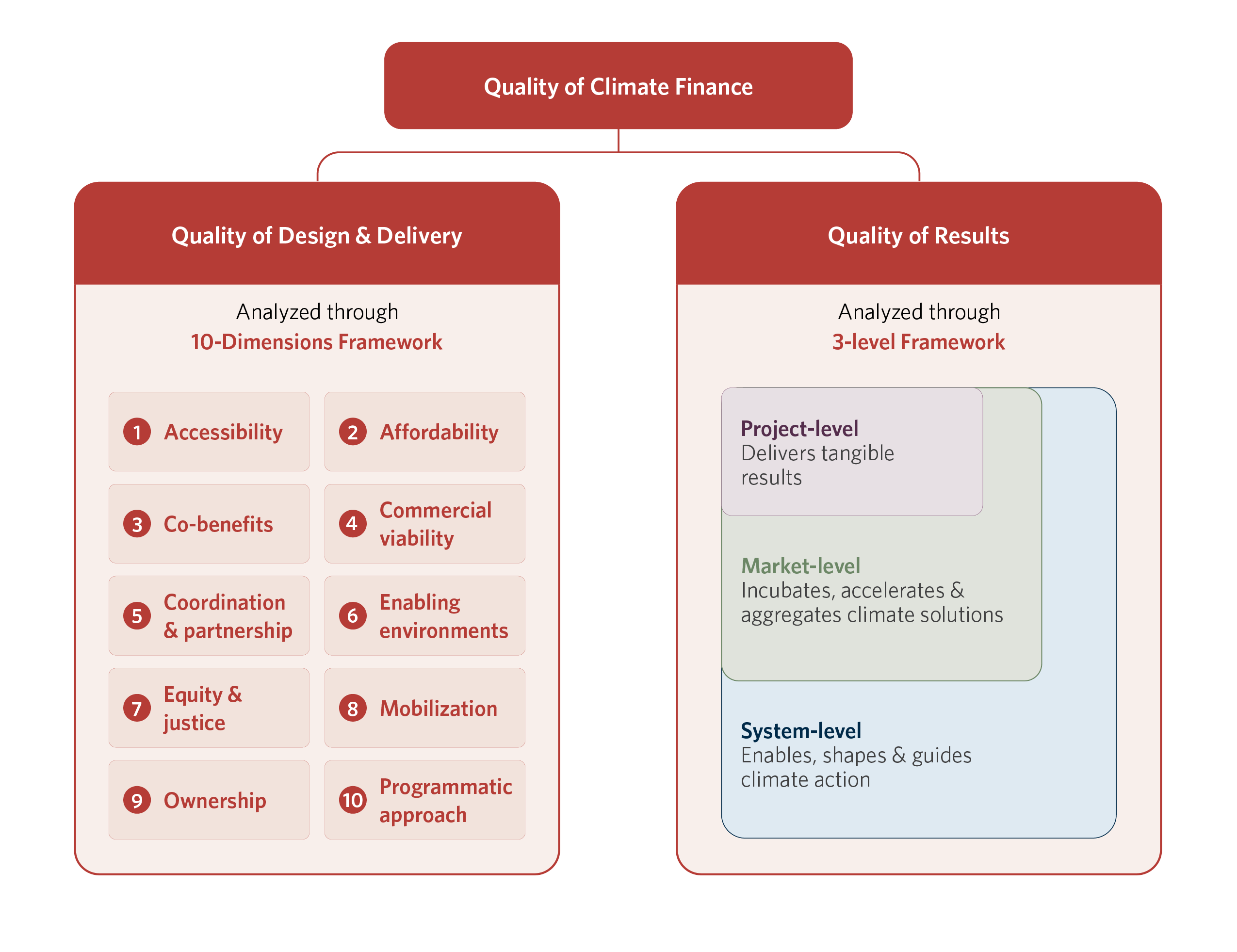
A key implication arising from this discussion paper is the need to unpack climate finance quality in terms of quality of design and delivery; and quality of results (see Figure ES3). Until now, CPI had packaged its work on climate finance quality under one umbrella framework with little distinction between design and delivery, and then results. This paper recommends a clearer and conscious differentiation between the two aspects in future CPI work and the broader climate finance quality dialogue, in order to facilitate more holistic assessments that cover both efficiency and equity perspectives.
Figure ES3: Holistic, two-pronged approach to assessing quality of climate finance