

State of Super Pollutants Abatement Finance
State of Super Pollutant Abatement Finance, from Climate Policy Initiative (CPI) and the Climate and Clean Air Coalition (CCAC), is the first report to establish a baseline of finance targeting super pollutant abatement. It maps where the money is going, identifies significant gaps, and sets out what is needed to scale investment.
Super pollutants (e.g. methane, black carbon and hydrofluorocarbons (HFCs)) is a less familiar term than “greenhouse gases,” but many trap far more heat than CO2. Together, they drive around half of today’s warming.
Because they break down quickly, cutting them acts like an emergency brake on near-term warming – one of the fastest, most cost-effective levers available at a moment when a 1.5°C overshoot is widely seen as unavoidable. Targeted action on super pollutants could roughly double the avoided warming by 2050, and triple it by 2100.
Where the finance is flowing
Explore all finance flows in the interactive sankey below.
Super pollutants attract little climate finance
Super pollutants drive roughly half of today’s warming. In 2023, they attracted just US$9 billion in traceable finance, roughly 1 in every 200 dollars of climate mitigation finance that year.
Methane gets the largest share, but still falls short
Methane takes the largest share of tracked finance at 59%, or $5.2 billion, but that is still only 4% of what’s needed to meet the Global Methane Pledge target, and 18% of what’s needed for achieving countries’ methane commitments (National Determined Contributions and Methane Action Plans).
Finance is concentrated in a few sectors
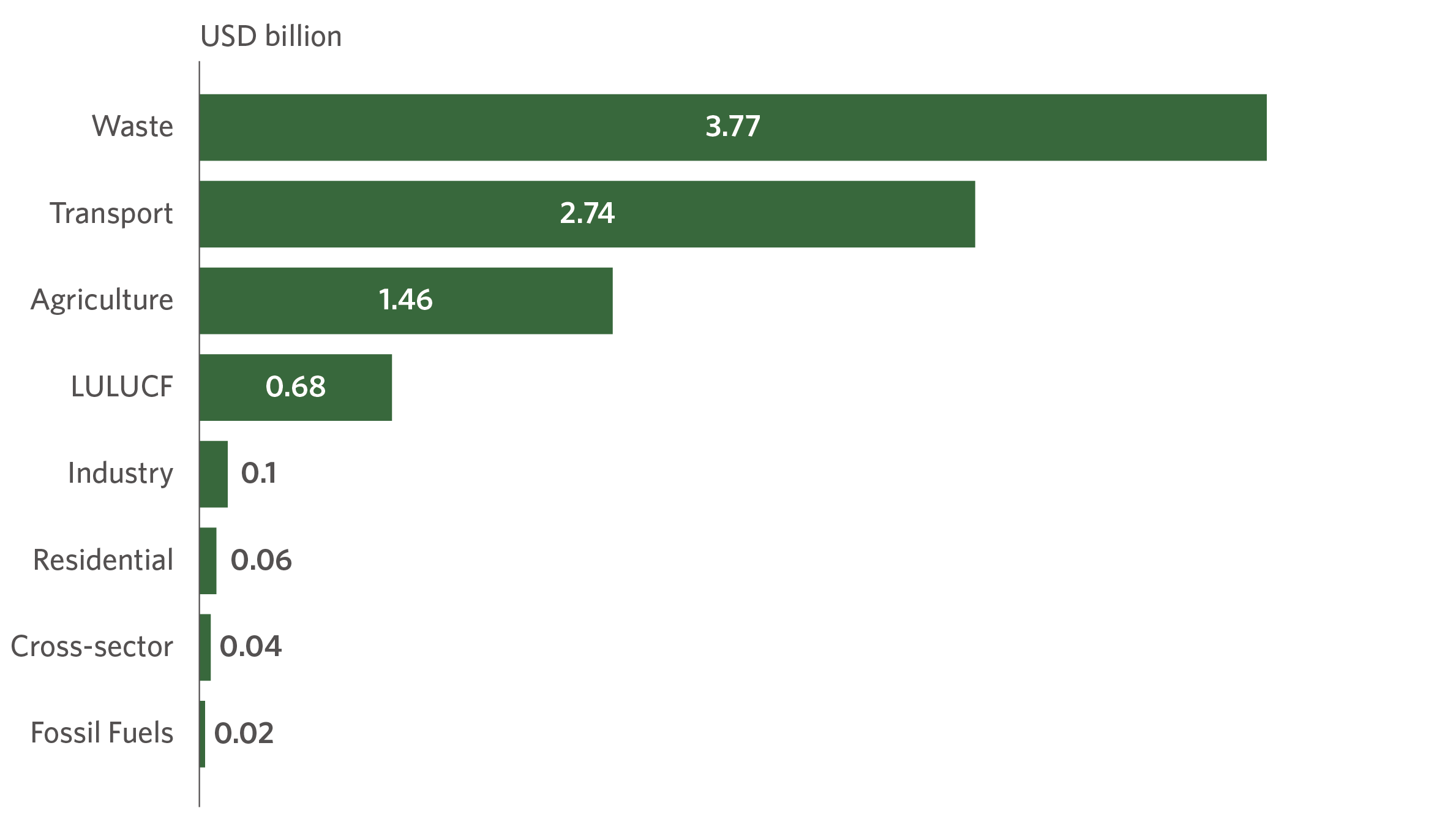
Waste and transport took nearly three-quarters of all finance between them. Waste received 42%, primarily from wastewater treatment and waste-to-energy. Followed by transport, 31% largely driven by green ammonia and hydrogen production and vessels for maritime transport. Agriculture and LULUCF accounted for 24% while industry, residential, cross-sector, energy generation and fossil fuel activities received 3%.
Super pollutant abatement flows per sector, 2023
Finance is unevenly distributed across regions
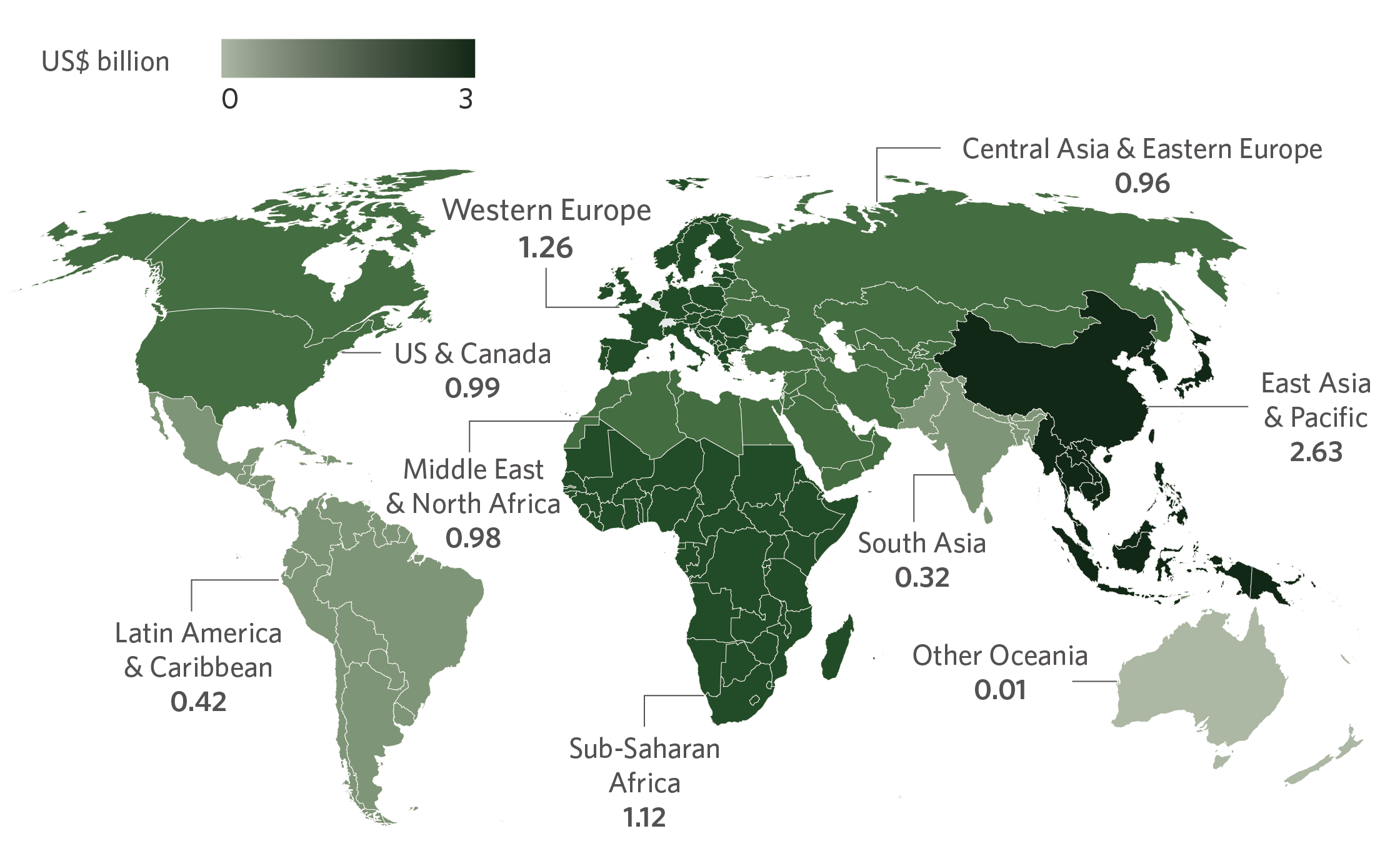
East Asia and the Pacific (30%) and Western Europe (14%) attracted the most finance, mostly private capital chasing commercial returns. Sub-Saharan Africa (13%) relied on international public finance instead, largely for waste, sanitation and agriculture.
Super pollutant abatement finance by region, 2023
Public and private funding play different roles
Public finance (54%) carries the load in developing countries and sectors with no clear revenue model. Private finance (45%) is overwhelmingly domestic, and concentrated in projects that are already bankable.
The agenda is moving, but the financing has not caught up
The world is already acting: the Kigali Amendment, the Global Methane Pledge, the EU’s 2024 Methane Regulation, and CCAC’s Super Pollutant Country Action Accelerator (launched at COP30) – all reflect growing political will. What’s lagged, the report finds, is the financing to match it.
The economic case: A companion UNEP–CCAC assessment, Hidden Assets found that every $1 invested in 25 proven integrated climate and clean air solutions could return around $15 in economic benefits. The assessment estimated that implementing 21 clean air and near-term climate solutions of these 25 would require around $500 billion a year by 2030, compared with an estimated $1.5 trillion initial investment for the full package of 25 solutions. By 2035, the full package could generate economic benefits equivalent to 2.8% of global GDP. These estimates are not directly comparable with the financial flows tracked in this report, but they illustrate the scale of investment required and the potential economic returns from action.
Three priorities for closing the gap
Two barriers are holding investment back: super pollutants are still inconsistently built into national climate plans and finance taxonomies, and even where opportunities are clear, few have been packaged into bankable projects. The report sets three priorities to close the gaps.
- Build the policy and data foundations: Embed super pollutants into national climate plans and disclosure requirements, enabling investors to see where the opportunities are.
- Turn fixes into fundable projects: Package technical solutions into investable projects that governments and financiers can put money behind.
- Mobilize the right capital: Use public and blended finance to de-risk projects where the payoff is high, but markets alone won’t move fast enough.
Explore the climate finance flows:
