

Transforming Brazilian Cattle Ranching: Enhancing Productivity and Mitigating Methane Emissions
Brazil occupies a unique position in global food production, particularly in cattle ranching. Over the past few decades, the country has consolidated its role as one of the world’s largest producers and exporters of beef, supported by large-scale production systems, significant land availability, and the ability to supply diverse international markets. This leadership, however, is being redefined. Growing global demands for sustainable production, climate mitigation, and supply chain traceability have become structural elements of agricultural trade, fundamentally reshaping the criteria for sectoral competitiveness.
In this context, productivity and sustainability are no longer parallel agendas; they have become inseparable components of the future of Brazilian cattle ranching. The climate challenge is not merely an external obstacle, but a central element shaping the sector’s growth strategy. Consequently, how Brazil responds to this challenge will directly influence its ability to maintain and strengthen its leadership in the global meat market.
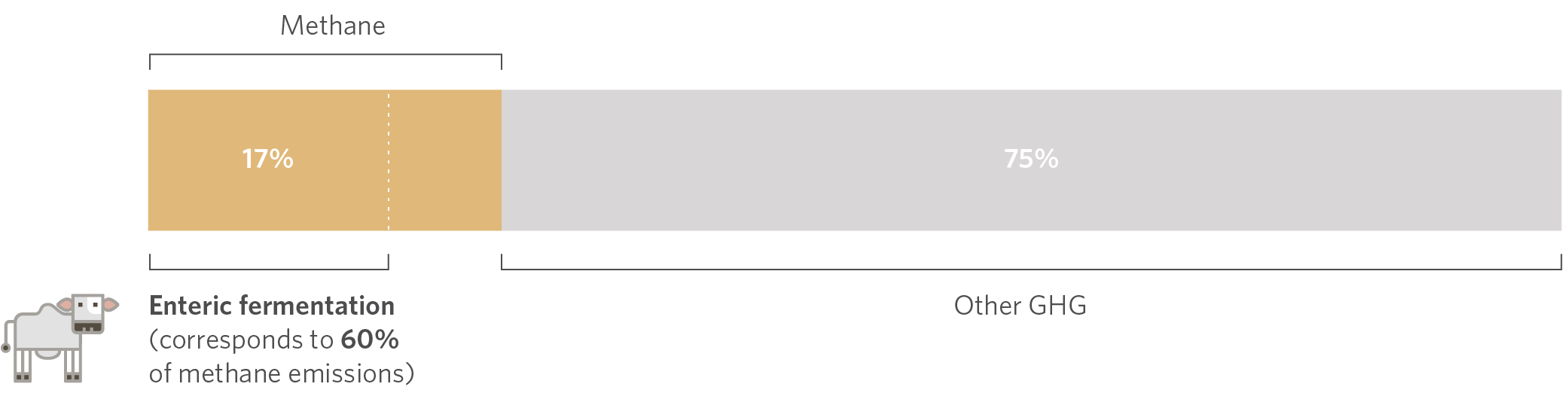
Methane occupies a pivotal position in this debate. As a highly potent greenhouse gas, it is a major contributor to Brazil’s emissions profile. More than 60% of the methane emitted in Brazil comes from the livestock sector, primarily from enteric fermentation in beef and dairy cattle (Figure 1) (SEEG 2025). Addressing methane emissions represents a critical opportunity for Brazil to increase productivity while simultaneously reducing its climate footprint. The country already benefits from established production technologies, robust frameworks for public policy and financial instruments, technical assistance, and advanced monitoring capabilities—all of which can drive large-scale transformations. Combined, these elements create a strategic opportunity to accelerate the sector’s transition toward carbon neutrality.
Figure 1. Methane and Enteric Fermentation Emissions in Brazil
Source: CPI/PUC-Rio with data from SEEG (2025), 2026
