


The Amazon in Focus: How to Redirect Public Resources to Support the Region’s Sustainable Development
Introduction
The Brazilian Amazon rainforest holds one of the world’s largest terrestrial carbon stocks and helps regulate the country’s water cycle through the flying rivers. These environmental services sustain agriculture and livestock, hydroelectric generation, river transportation, and urban water supply across Brazil. Given its environmental, economic, and social importance, the Amazon rainforest is, above all, a strategic national asset.
Yet the 28 million inhabitants of the Brazilian Amazon live with indicators of income, poverty, labor informality, and urban infrastructure that lag behind those of the rest of the country. The region faces critical development challenges: its economy remains stagnant and is characterized by low productivity, while its agricultural model is still carbon-intensive and often dependent on deforestation.
It is commonly argued that this situation stems from the absence of government presence in the region. From an economic standpoint, this explanation falls short. The federal government has a significant presence in the region through public banks, constitutional funds, subsidized credit, tax incentives, and major infrastructure investments. The issue, therefore, is not a lack of government action, but how that action is directed and how efficiently resources are used. A significant share of these resources is still directed toward frontier expansion and low-productivity activities that generate short-term returns. Moreover, government-led development initiatives often fail to strengthen territorial governance, leaving land tenure issues unresolved across the region.
This report builds on this premise and analyzes specific credit and tax expenditure instruments under the purview of the Ministry of Finance: the Constitutional Fund for Financing the North (FNO), operated by the Bank of the Amazon (Basa); the Manaus Free Trade Zone (ZFM); and the Financial Compensation for the Exploitation of Mineral Resources (CFEM).[1]
Why Brazil Needs to Rethink its Strategy for the Amazon
The Brazilian Amazon, home to most of the largest tropical rainforest on the planet, is a strategic asset for Brazil because of its unparalleled wealth of natural resources. The region plays a key role in climate regulation: it stores one of the largest terrestrial carbon stocks on the planet and helps regulate the continental water cycle through the so-called flying rivers (Nobre, 2014). The forest provides essential environmental services (climate, water, and biodiversity) that support agriculture and livestock, hydroelectric power generation, river transportation, and urban water supply in Brazil (Nobre, 2014; Pinto and Arbache, 2025a).
However, the region faces enormous social and economic challenges. Its 28 million inhabitants live with health, education, sanitation, and public safety indicators that are worse than those in the rest of the country (Wilm et al., 2026; Soares et al., 2025). The regional economy is stagnant and has low productivity, and its agricultural production system remains carbon-intensive. Moreover, about 29% of the region’s territory has undefined land tenure status, which weakens environmental protection, undermines property rights, and discourages sound investment (Brito et al., 2021; Veríssimo et al., 2022).
The key issue is not a lack of public policies or the absence of the federal government in the region. The State is present through rural credit, constitutional funds, tax incentives, royalties from the mining, oil and gas sectors, and major infrastructure projects. The problem is that a significant share of these instruments remains geared toward frontier expansion (such as new roads that drive deforestation and social conflict), low-productivity activities, and short-term spending—without generating governance, land tenure security, quality jobs, and social progress on the same scale.
Whenever the Brazilian government expands the settlement frontier in the Amazon by building roads, deforestation increases. Road construction sharply increases the supply of cheap land, making it more profitable to clear the forest than to invest in sustainable land use. Land tenure insecurity exacerbates this pattern, as it prevents land from being used as collateral for credit and turns land occupation into a race for property rights and a source of conflict (Schneider, 1995).
The result is a familiar combination: environmental crisis, sluggish economic growth, rising violence, and high social costs. In 2024, the Brazilian Amazon accounted for just over 9% of Brazil’s Gross Domestic Product (GDP), but for about 44% of the country’s greenhouse gas (GHG) emissions, mainly from deforestation and fires (Seeg, 2025).
Yet each of the factors behind the region’s crisis also holds the basis for a structural solution—the so-called “Amazon paradox” (Veríssimo, Assunção, and Barreto, 2022). First, the Amazon has vast areas of cleared and underused land that could support more productive agriculture and livestock, as well as large areas for restoration and other forest-based activities. Second, the remaining forest is increasingly valuable for the environmental services it provides to the climate and to biodiversity. Finally, the region’s predominantly young population can sustain a cycle of growth if there are significant improvements in education and technical training, digital connectivity, public safety, and economic opportunities (Veríssimo, Assunção, and Barreto, 2022; Turra et al., 2022; Cruz and Portella, 2021).
The Forest as National Infrastructure
Beyond its environmental value, the Amazon rainforest functions as Brazil’s natural infrastructure. Evapotranspiration from the forest recycles moisture and feeds the flying rivers, which supply rainfall to agricultural regions, hydroelectric reservoirs, urban water supply systems, and waterways (Nobre, 2014; Pinto and Arbache, 2025a).
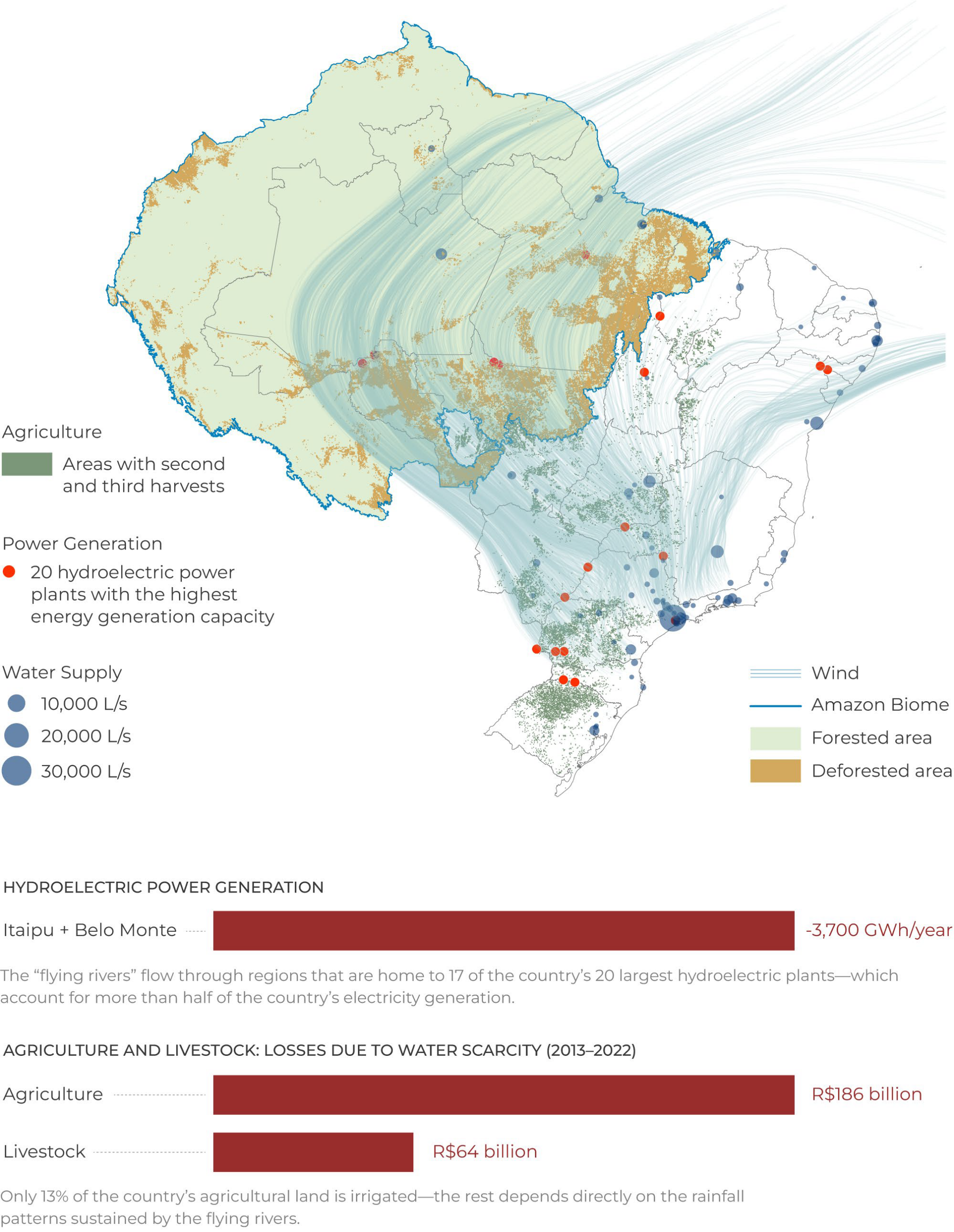
These services provide direct economic benefits. Hydroelectric plants account for more than half of Brazil’s electricity generation (EPE, 2025). Brazilian agriculture also depends heavily on rainfall, as only 13% of agricultural land is irrigated (Pinto and Arbache, 2025a). As the Amazon rainforest is cleared, it loses its capacity to recycle moisture, increasing risks to power generation, food production, river transportation, and water supply.
The flying rivers pass over regions that are home to 17 of Brazil’s 20 largest hydroelectric plants (Figure 1). The Itaipu and Belo Monte plants alone lose approximately 3,700 GWh of potential generation each year, equivalent to the annual electricity consumption of the state of Rondônia (Pinto and Arbache, 2025b). In agriculture, the National Confederation of Municipalities (CNM) estimated losses of R$186 billion in crop production and R$64 billion in livestock production due to water scarcity between 2013 and 2022 (CNM, 2023).
Deforestation has also become a trade risk. The European Union Deforestation Regulation (EUDR) requires proof that beef, soy, palm oil, cocoa, coffee, rubber, and timber were not produced on land deforested after December 31, 2020 (European Union, 2023). The regulation provides for risk-based differentiation: low-risk countries will benefit from simplified procedures, while high-risk countries will be subject to enhanced controls (Barreto et al., 2025). Estimates from Chain Reaction Research indicate that the regulation could reduce the profits of large Brazilian meatpackers, which could also face fines of up to 4% of their sales to the European Union (Chain Reaction Research, 2022).
In June 2026, the Tianjin Meat Association (China) formalized the purchase of at least 50,000 metric tons of Brazilian beef certified as deforestation-free. Participating companies have begun auditing imports with a Chinese certification body and will be able to market the meat with specific labeling. According to the Chinese press, the product is expected to reach premium supermarkets, restaurants, and digital platforms despite an estimated price premium of 5% to 10% (Xinhua News Agency, 2026).
Mining adds another dimension to the Amazon’s national importance, as the region holds strategic mineral reserves such as iron ore, bauxite, copper, and nickel. However, weak territorial governance and slow progress in land tenure regularization have limited the region’s ability to turn this potential into development.
In the gold sector, industrial mining has been losing ground to illegal small-scale mining, with serious social and environmental consequences. In this context, gold mining ceases to be a productive activity and instead fuels illegal economies (Soares, Pereira, and Pucci, 2021; Soares et al., 2025).
Figure 1. The Path of the Flying Rivers
Source: CPI/PUC-Rio with data from Copernicus-ERA5 (2023), ONS (2023), MapBiomas (2023), CCEE (2023), ANA (2020), Nobre (2014), Pinto and Arbache (2025a, 2025b), EPE (2025), CNM (2023)
The Social Progress Gap
In 2023, per capita GDP in the region was R$39,000, compared with R$56,000 in the rest of Brazil (Santos et al., 2026). In 2025, average monthly household income per capita in the region was only R$1,416, compared with R$2,069 nationally. That same year, 37% of the Amazon’s population lived below the poverty line, compared with 23% in Brazil as a whole, and labor informality reached 47%, compared with 39% in the rest of the country (IBGE, 2026).
Young people account for a significant part of this challenge. In 2019, 57% of people age 18 to 24 and 40% of those age 25 to 29 were not employed (Alfenas et al., 2020; Veríssimo, Assunção, and Barreto, 2022). This matters because the Amazon has greater potential to benefit from a demographic dividend than other Brazilian regions. Without adequate professional training and job opportunities, however, this demographic advantage risks becoming a source of social pressure.
Vocational education is still incipient in the region. In 2020, enrollment in vocational and technical education was only 2% in the Brazilian Amazon, compared with 4% in the rest of the country and 42% in member countries of the Organization for Economic Co-operation and Development (OECD) (Cruz and Portella, 2021).
Urban infrastructure is limited. Only 13% of households have broadband access, compared with 53% in the rest of the country. Waste collection reaches 69% of households, compared with 81% in other states (IBGE, 2026).
Taken together, these indicators show that the region’s settlement and development process has failed to create favorable conditions for its population. The public policies and resources allocated to the region have not closed the gap with the rest of the country.
Table 1. Social Indicators for the Brazilian Amazon
| Indicator | Brazilian Amazon | Rest of Brazil | Year | Source |
| Real GDP per capita | R$ 39 mil | R$ 56 mil | 2023 | IBGE (2025) |
| Household income Average per capita | R$ 1,416 | R$ 2,069 | 2025 | IBGE (2026) |
| Poverty rate (%) | 37 | 23 | 2025 | IBGE (2026) |
| Informal employment rate (%) | 47 | 39 | 2025 | IBGE (2026) |
| Probability of transition from formal employment to informal work (%) | 13 | 8 | 2012–2020 | Alfenas et al. (2020) |
| Discouragement rate (%) | 5 | 2 | 2019 | Alfenas et al. (2020) |
| Youth not employed, 18 to 24 anos (%) | 57 | 48 | 2019 | Alfenas et al. (2020) |
| Youth not employed, 25 to 29 anos (%) | 40 | 30 | 2019 | Alfenas et al. (2020) |
| Access to sewer system (%) | 20 | 62 | 2025 | IBGE (2025) |
| Homes with plastered walls (%) | 54 | 82 | 2025 | IBGE (2025) |
| Homicide rate per 100,000 inhabitants | 18 → 28 | 27 → 17 | 2000–2023 | Ministry of Health (2025) and EstimaPop, IBGE (2025) |
| Life expectancy | 75.6 years | 76.8 years | 2024 | IBGE (2025) |
Building Opportunity Where People Already Live
The Brazilian Amazon is also an urban region. About two-thirds of its population lives in cities, which account for 83% of jobs (Chein and Procópio, 2022). A regional development strategy must therefore treat cities as hubs of productivity, employment, and services, not merely as support centers for the forest or the countryside.
The first step is to improve basic urban infrastructure. Sanitation, reliable energy, digital connectivity, local mobility, public safety, and facilities for education, culture, sports, and recreation lower costs for businesses and workers. These improvements help retain young people and create the conditions for higher-value-added activities in health care, education, information technology, tourism, gastronomy, the creative economy, and urban logistics.
Digital connectivity deserves priority because it expands opportunities without repeating the historical pattern of physical frontier expansion. In a region where new roads can lead to land grabbing, deforestation, and unregulated settlement, the internet provides access to education, public services, markets, and employment with less pressure on the forest (Araújo et al., 2022). Broadband, distance learning, telemedicine, and the digitization of public services can reduce isolation and connect urban and rural populations to new opportunities.
Vocational training is essential, particularly for young people. The Amazon still has a significant demographic window of opportunity, but this potential will only translate into growth if training is aligned with regional demand (Turra et al., 2022). Technical courses and short-term programs should prioritize entrepreneurship and employment opportunities in services, technology, the creative economy, health and well-being, bioeconomy, and urban services (Cruz and Portella, 2021).
Agriculture and Livestock: Producing More on Less Land
The development of the Brazilian Amazon no longer requires clearing forests. Since 1975, the region has lost approximately 86 million hectares of forest, an area roughly the size of Spain and Italy combined. Over this period, cumulative deforestation rose from 0.5% of the original forest area in 1975 to 21% in 2025 (INPE, 2025). Because much of this land is degraded, abandoned, or underused, the opportunity now lies in making better use of it.
Cattle ranching illustrates the scale of potential productivity gains. Amazon 2030 studies indicate that approximately 25 million hectares would be enough to meet projected beef demand in 2030. With higher productivity, up to 37 million hectares could be freed up for forest restoration, agroforestry systems, planted forests, and other land use (Barreto, Pereira, and Rocha, 2024; Barreto et al., 2025). The challenge is to realign incentives: credit, technical assistance, pasture recovery, and traceability should support producing more on less land rather than expanding into new forest areas.
The forest bioeconomy also remains far below its potential. Forest-compatible products, such as cocoa, black pepper, Brazil nuts, açaí, fish, and tropical fruits, have an international market worth more than US$288 billion a year. Although Brazil is home to about one-third of the world’s tropical forests, the Brazilian Amazon captures less than 0.3% of this market (Coslovsky, 2026). Other tropical countries, such as Bolivia, Ecuador, Peru, Vietnam, and Uganda, hold significant shares of these markets despite facing similar or even greater structural constraints (Coslovsky, 2021). The problem, therefore, lies mainly in the absence of a comprehensive agenda to promote these products, focused on operational efficiency, innovation, productivity, trade promotion, and strong pre-competitive arrangements.
Forest restoration broadens this productive agenda. The Brazilian Amazon has approximately 15 million hectares of deforested or abandoned land that is not used for crop or livestock. Of this total, 7.2 million hectares have been regenerating naturally for more than six years (Pinto et al., 2021). More broadly, approximately 37 million hectares of deforested land could be allocated to forest restoration and other production systems, such as agroforestry and reforestation, without affecting regional agricultural output (Veríssimo et al., 2022). At a carbon price above US$25 per metric ton of CO₂ removed through natural regeneration, forest restoration would become more profitable than extensive cattle ranching across the entire region, with the potential to generate an estimated US$ 320 billion in gross revenue over the next 30 years (Assunção and Scheinkman, 2023).
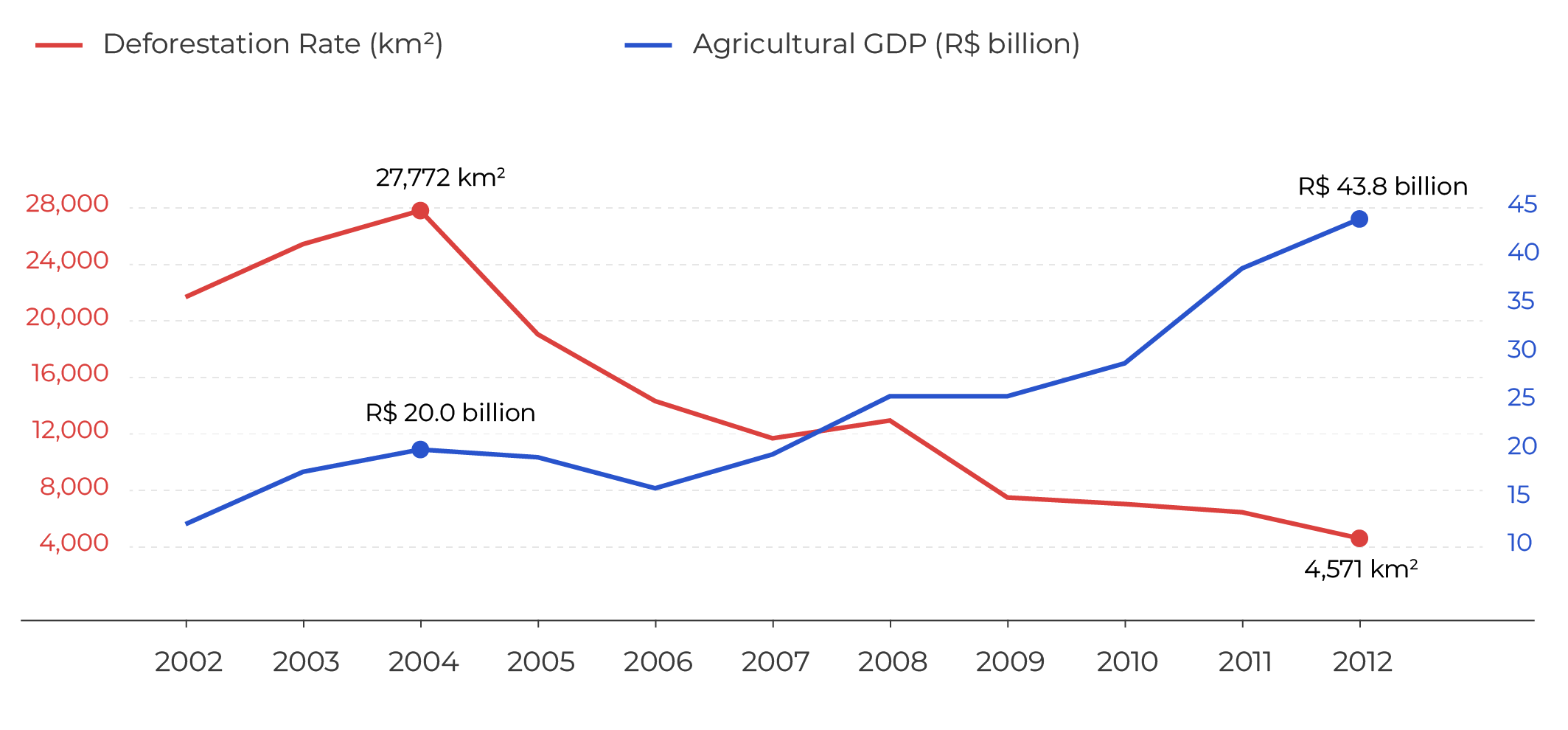
Brazil has already shown that it can reduce deforestation without sacrificing economic growth in the Brazilian Amazon. Between 2004 and 2012, deforestation in the Brazilian Amazon fell by more than 80%, while the region’s agricultural GDP more than doubled (Figure 2) (Gandour, 2021). More recently, Brazil has again cut deforestation, from 13,038 square kilometers in 2022 to 5,731 square kilometers in 2025 (INPE, 2026). This track record shows that environmental protection and agricultural growth are not mutually exclusive.
Figure 2. Deforestation Rate and Agricultural GDP, 2002–2012
Source: Amazon 2030 with data from Gandour (2021)
Security: Restoring State Control over the Territory
The business environment in the Brazilian Amazon has been undermined by rising violence and organized crime. Between 2000 and 2024, the homicide rate in the region rose from 18 to 28 per 100,000 inhabitants (peaking at 43 in 2018). Over the same period, the rate in the rest of Brazil fell from 27 to 17 per 100,000 inhabitants (Ministry of Health, 2025). By 2019, the regional rate was already 70% higher than in the rest of the country (Soares et al., 2025).
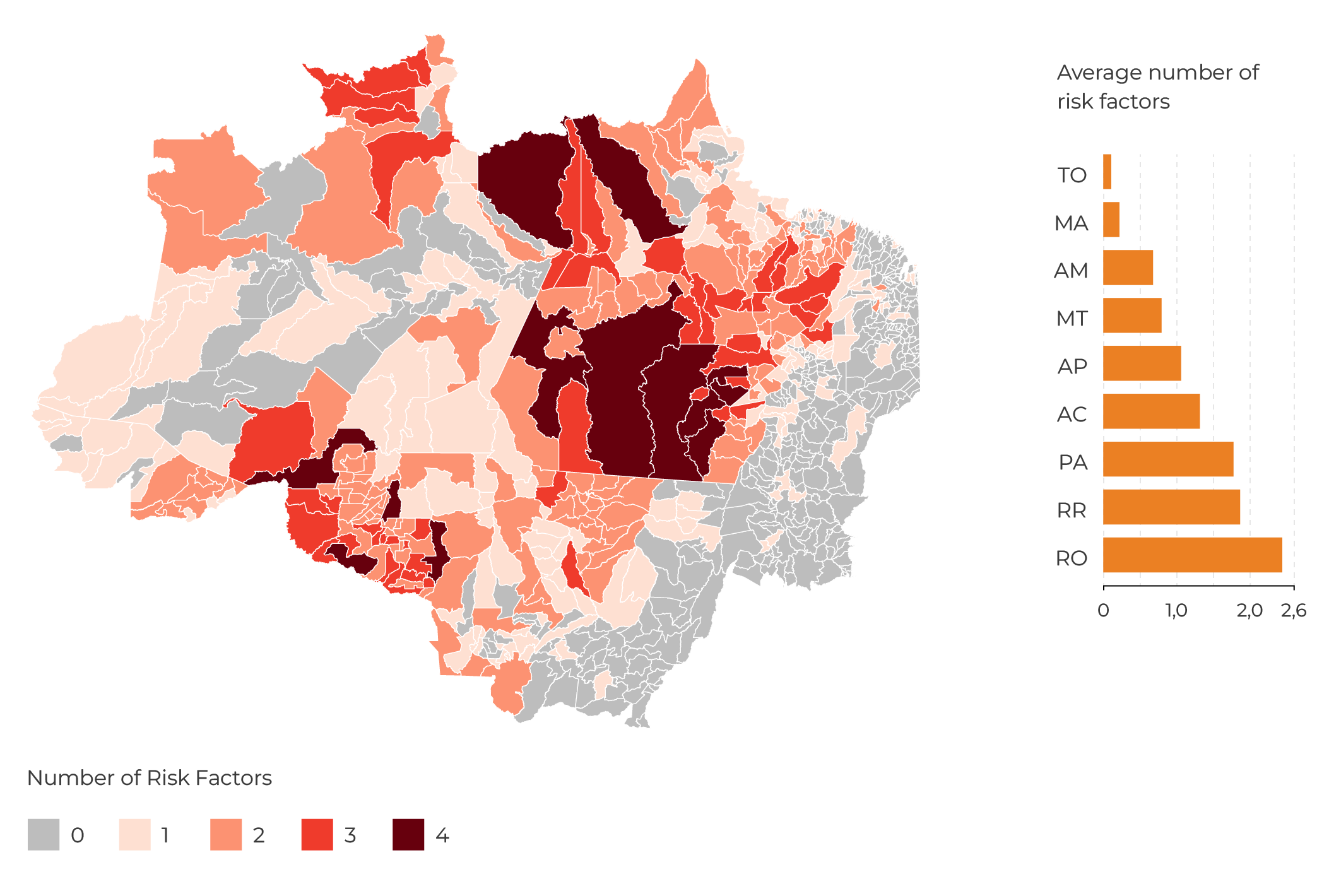
The dynamics of violence in the Brazilian Amazon have changed. Until the mid-2000s, the main risk factor was illegal logging. Land grabbing and illegal gold mining then gained prominence (Figure 3). Since 2018, however, drug trafficking routes and the presence of criminal factions have reshaped violence in the region (Soares, Pereira, and Pucci, 2025). Between 1999 and 2023, an estimated 18,367 homicides could have been prevented in small municipalities in the Brazilian Amazon had illegal logging, land grabbing, illegal gold mining, and criminal factions not been present (Pereira, Pucci, and Soares, 2025).
Rivers in the Brazilian Amazon have become major routes for international cocaine trafficking, connecting the Andean countries (Bolivia, Colombia, and Peru) to the city of Manaus and, from there, to domestic and international markets (Pereira, Pucci, and Soares, 2025). The number of Amazonian municipalities with a criminal faction presence rose from 178 in 2023 to 344 in 2025. Between 2018 and 2023, criminal factions accounted for 56% of homicides linked to these risk factors, up from 29% before 2018 (FBSP, 2023, 2024, 2025).
Land tenure insecurity exacerbates this dynamic. About 29% of the Brazilian Amazon, roughly 144 million hectares, still has undefined land tenure. Of this total, about 57 million hectares are undesignated public forests, an area the size of France (Brito, 2022; Brito et al., 2021). Nearly 300,000 occupied landholdings on federal public lands lack regularized tenure. Yet current legislation would allow 88% of the titling applications filed with the National Institute for Colonization and Agrarian Reform (Incra) to be processed quickly, without loosening rules in ways that would reward land grabbing (Brito, 2022).
Without land-use planning, attracting high-quality investment to the region remains extremely difficult. Land tenure regularization for legitimate claimants, the allocation of undesignated public forests, and public land concessions for restoration all depend on coordination among Incra, the Chico Mendes Institute for Biodiversity Conservation (ICMBio), the Brazilian Forest Service (SFB), the National Foundation for Indigenous Peoples (Funai), and state land agencies (Brito, 2022; Brito et al., 2021).
Figure 3. Exposure to Risk Factors in the Brazilian Amazon
Source: Santos et al. (2026)
Rethinking Economic Incentives
It is often argued that the Brazilian Amazon suffers from a chronic absence of government presence. This interpretation is incomplete. The federal government is present in the region through public banks, constitutional funds, subsidized credit, tax incentives, and major infrastructure projects. The problem is that government actions and investments have often been poorly suited to the realities of the Brazilian Amazon. In many cases, public resources continue to finance land occupation patterns and investments that disregard the region’s specific characteristics and do little to boost productivity, innovation, land tenure security, and social progress.
Rural credit is the first area in need of reform. Public credit should prioritize higher agricultural and livestock productivity, the restoration of degraded land, and forest-based activities, rather than the extensive land-use model that drives deforestation. The same logic applies to the forest-compatible products. Financial resources currently concentrated in conventional supply chains need to be redirected toward agroforestry systems, bioeconomy, and forest restoration (Mourão et al., 2024; Barreto, Pereira, and Rocha, 2024; Barreto et al., 2025; Coslovsky, 2021).
The Constitutional Fund for Financing the North (FNO), operated by the Bank of the Amazon (Basa), is a key instrument for promoting productive activities in the region.[2] Between 2020 and 2025, the total value of contracted loans exceeded R$ 70 billion. However, because most establishments now qualify as priority beneficiaries, the FNO has lost its capacity to target credit. One recommended adjustment is to concentrate resources on smaller producers and on areas facing greater credit constraints (Pereira and Souza, 2022). Furthermore, credit lines designed to promote more sustainable activities, such as FNO-ABC (low-carbon agriculture), still account for only a small share of total lending.
The Manaus Free Trade Zone (ZFM) needs to be more closely integrated with the regional economy.[3] With the ZFM’s tax benefits now extended through 2073, it has become more urgent to link incentives to the creation of skilled jobs, workforce training, infrastructure, bioeconomy, technology, and specialized services. International experience with special economic zones shows that incentives are most effective when tied to clear performance requirements for productivity, local integration, and workforce training (Schutze et al., 2021; Assunção et al., 2020).
Mining royalties should finance permanent assets. The Financial Compensation for the Exploitation of Mineral Resources (CFEM)[4] is revenue derived from a finite and volatile resource. Under current arrangements, mining municipalities are vulnerable to the mineral price cycle, and royalties tend to crowd out their own-source revenue (Araújo and Bragança, 2022). In 2025, total CFEM revenue in the Brazilian Amazon reached approximately R$ 3.4 billion, more than 92% of it in the state of Pará. To make the CFEM more effective, the rules governing its use should be tightened, with mechanisms to smooth revenue fluctuations and to increase investment in infrastructure, health, education, and long-term planning. Above all, CFEM resources should prioritize diversifying the local economy so that municipalities do not suffer economic and social collapse when mineral resources are depleted.
Table 2. Public Finance Instruments: key challenges and recommendations
| Instrument | Evidence | Problem | Recommendation |
| Rural Credit | The 2024/25 Agricultural Plan (Plano Safra) disbursed R$ 475.5 billion in rural credit , with R$ 16.7 billion in subsidies. Between 2020 and 2024, 36% of subsidized rural credit was allocated to properties where deforestation occurred after 2009. At the Amazon Bank, more than 70% of subsidized credit is associated with properties where deforestation has occurred (Mourão et al., 2024). | Part of the public subsidy goes to properties with recurring deforestation, both before and after the credit is granted. | Adjust instruments and stakeholder incentives so that rural credit promotes the productive restoration of already-converted areas. Block subsidized credit to producers who deforest. |
| Livestock Credit | Credit specifically for livestock farming requires special attention because of its potential for either negative or positive impacts. | Credit still finances extensive, low-productivity ranching and frontier expansion rather than the intensification of already-cleared pastures. | Make credit conditional on the adoption of technical assistance, the restoration of degraded areas, and traceability. Concentrate credit in consolidated areas and within a radius of up to 80 km from meatpacking plants. |
| Forest-Compatible Products | Rural credit virtually ignores forest-compatible supply chains, even though the international market for these products is worth more than US$ 288 billion annually. The Brazilian Amazon captures less than 0.3% of this market (Coslovsky, 2026). | Forest and agroforestry supply chains are excluded from the main rural financing instrument. | Prioritize credit for forest-compatible supply chains. Facilitate access for producers in this sector. Foster operational efficiency, innovation, productivity, trade promotion, and pre-competitive arrangements. |
| Constitutional Fund for Financing the North (FNO) | The FNO is funded by 0.6% of income tax and IPI revenue. In 2019, R$ 9.3 billion was budgeted, more than three times the regional disbursement by the Brazilian Development Bank (BNDES). However, 97% of establishments qualified as priority, and the ceiling for the small-to-medium size category reached R$ 16 million (Pereira and Souza, 2022). | Overly broad criteria dilute prioritization. | Revise the selection criteria to concentrate resources on smaller producers and in consolidated regions. Goal: implement credit lines for the most sustainable activities, such as FNO-ABC (low-carbon agriculture). |
| Manaus Free Trade Zone (ZFM) | In 2019, the ZFM received more than R$ 5 billion in tax exemptions. The Manaus Industrial Hub comprised about 500 companies, with revenues of R$ 105 billion. Only 2% of sales were exported; 65% of inputs were imported; 59% of employees earned up to twice the minimum wage; and wages accounted for 5% of revenue, compared with a national average of 11%. The ZFM’s benefits have been extended through 2073 (Schutze et al., 2021; Assunção et al., 2020). | The tax incentive has little connection to exports, regional suppliers, productivity gains, or the Amazon’s comparative advantages. | Link incentives to the creation of skilled jobs, workforce training, infrastructure, bioeconomy development, technology, and specialized services. Tie them to clear productivity and local-integration requirements. |
| Mining Royalties | Pará’s mining revenues exceeded R$ 103.1 billion in 2025, accounting for more than 80% of the state’s exports. Between 2007 and 2025, R$ 16.7 billion in CFEM was transferred to municipalities in Pará; Parauapebas and Canaã dos Carajás received 82% of the total (ANM, 2025). About half of any increase in CFEM revenue tends to go to current expenditures. Canaã dos Carajás relies on royalties for 63% of its revenue, and Parauapebas for 40% (Araújo and Bragança, 2022). | Mineral wealth is not being converted, on the necessary scale, into infrastructure, health care, education, and long-term planning capacity. | These funds must be used exclusively for investments in infrastructure, health, education, and long-term planning and should supplement the municipality’s financial responsibilities. Investments must always aim to support the municipality’s economic transition to a post-mining economy. |
A Sustainable Amazon Requires Rethinking the Government’s Role in the Region
Brazil has the tools to change the Amazon’s development trajectory, but doing so requires a shift in focus. The same public banks, constitutional funds, and tax incentives that often finance frontier expansion—keeping the region trapped in a vicious cycle of low productivity, informality, and deforestation—can be redirected toward more intensive, productive, and deforestation-free land uses. Standing forests, agroforestry, and forest-based activities, including restoration, must also be recognized as essential to the region’s development.
Brazil has already shown that it can drastically reduce deforestation through well-coordinated command-and-control measures. But curbing deforestation, while necessary, is not enough. An equally coordinated set of measures is needed to turn already-deforested land, the remaining forest, and the region’s young workforce into sources of productivity, income, and jobs.
References
ANM – National Mining Agency. 2025. Collection of the Financial Compensation for the Exploitation of Mineral Resources (CFEM).
Alfenas, Flávia, Francisco Cavalcanti, and Gustavo Gonzaga. 2020. Job Market in the Brazilian Amazon: A Comparative Analysis between the Brazilian Amazon and the Rest of the Country. Amazônia 2030.
Araújo, Rafael, and Arthur Bragança. 2022. Mining Royalties and Socioeconomic Development in Pará. CPI/PUC-Rio.
Araújo, Rafael, Arthur Bragança, and Juliano Assunção. 2022. Accessibility in the Legal Amazon: Digital Solutions. Amazônia 2030.
Assunção, Juliano, and José A. Scheinkman. 2023. Carbon and the Fate of the Amazon. CPI/PUC-Rio and Amazônia 2030.
Assunção, Juliano, Amanda Schutze, and Rhayana Holz. 2020. Does the Manaus Free Trade Zone Have an Impact on Industry Efficiency? CPI/PUC-Rio.
Barreto, Paulo, Ritaumaria Pereira, and Arthur José da Silva Rocha. 2024. From “Scarcity” to Abundance: The Case of Cattle Ranching in the Amazon. Belém: Amazônia 2030/Imazon.
Barreto, Paulo, Arthur José da Silva Rocha, Amintas Brandão, Ritaumaria Pereira, and Gabriel Salles Barreto. 2025. Lessons from the Expansion of Cattle Ranching in Brazil (2000–2023) for Sustainable and Efficient Production. Belém: Amazônia 2030.
Brito, Brenda. 2022. Land Tenure Regularization on Federal Lands in the Amazon. Amazônia 2030.
Brito, Brenda, Jeferson Almeida, Pedro Gomes, and Rodney Salomão. 2021. Dez Fatos Essenciais sobre Regularização Fundiária na Amazônia [Ten Essential Facts about Land Tenure Regularization in the Amazon]. Belém: Imazon.
Chain Reaction Research. 2022. JBS, Marfrig, and Minerva Unlikely Compliant with Upcoming EU Deforestation Law.
Chein, Flávia, and Igor Procópio. 2022. As Cidades na Amazônia Legal: Diagnóstico, Desafios e Oportunidades para Urbanização Sustentável [Cities in the Legal Amazon: Diagnosis, Challenges, and Opportunities for Sustainable Urbanization]. Amazônia 2030.
CNM – National Confederation of Municipalities. 2023. Technical Study: Agricultural and Livestock Losses in the Last 10 Years.
Coslovsky, Salo. 2021. Opportunities for Exporting Forest-Compatible Products from the Brazilian Amazon. Amazônia 2030.
Coslovsky, Salo. 2026. Productive Reforestation, Conservation, and Economic Development in the Brazilian Amazon. Amazônia 2030.
Coslovsky, Salo, and Beto Veríssimo. 2025. To Protect the Amazon, We Have to Reforest It. Amazônia 2030, Policy Brief #4.
Cruz, Tássia, and Juliana Portella. 2021. Education in the Legal Amazon: Assessment and Critical Factors. Amazônia 2030.
EPE – Energy Research Office. 2025. Statistical Yearbook of Electricity 2025.
European Union. 2023. Regulation (EU) 2023/1115 of the European Parliament and of the Council of May 31, 2023 (European Union Deforestation Regulation).
FBSP – Brazilian Public Security Forum. 2023, 2024, 2025. Mapping the Presence of Criminal Factions in the Municipalities of the Brazilian Amazon.
Gandour, Clarissa. 2021. Public Policies for the Protection of the Amazon Forest: What Works and How to Improve. Amazônia 2030.
IBGE – Brazilian Institute of Geography and Statistics. 2025/2026. Continuous National Household Sample Survey (PNAD Contínua).
INPE – National Institute for Space Research. 2025. PRODES: Satellite Monitoring of Deforestation in the Brazilian Legal Amazon.
INPE – National Institute for Space Research. 2026. PRODES: Annual Deforestation Rates in the Brazilian Legal Amazon.
Ministry of Health. 2025. Mortality Information System (SIM/DATASUS).
Mourão, João, Mariana Stussi, and Priscila Souza. 2024. CAR a CAR: As Instituições Financeiras e o Crédito para Propriedades com Desmatamento [CAR by CAR: Financial Institutions and Credit for Properties with Deforestation]. CPI/PUC-Rio.
Nobre, Antonio D. 2014. The Future Climate of Amazonia: Scientific Assessment Report. São José dos Campos: Articulación Regional Amazónica.
Soares, Rodrigo R., Leila Pereira, and Rafael Pucci. 2021. Illegality and Violence in the Amazon.
Pereira, Leila, and Priscila Souza. 2022. Priorities That Don’t Prioritize: The Mismatch Between Objectives and the Allocation of Resources from Constitutional Funds Leads to Credit Concentration in the Rural Sector. CPI/PUC-Rio.
Pereira, Leila, Rafael Pucci, and Rodrigo R. Soares. 2025. Landing on Water: Aerial Interdiction, Drug Trafficking, and Violence in the Brazilian Amazon. Amazônia 2030.
Pinto, Andréia, Paulo Amaral, Rodney Salomão, Luís Oliveira Jr., Carlos Alexandre da Cunha, and Lucas Figueiredo. 2021. Large-Scale Forest Restoration in the Amazon: The Potential of Secondary Vegetation. Amazônia 2030.
Pinto, Gustavo R. S., and João Pedro Arbache. 2025a. When the River Runs Dry: How Amazon Deforestation Threatens the Brazilian Economy. Rio de Janeiro: CPI/PUC-Rio and Amazônia 2030.
Pinto, Gustavo R. S., and João Pedro Arbache. 2025b. Deforestation Cuts Off the Light: Itaipu, Belo Monte, and the Price of the Lost Forest. CPI/PUC-Rio and Amazônia 2030.
Santos, Daniel et al. 2026. Facts About the Amazon 2026. Amazônia 2030.
Schneider, Robert R. 1995. Government and the Economy on the Amazon Frontier.
Washington, D.C.: World Bank.
Schutze, Amanda, Rhayana Holz, and Juliano Assunção. 2021. Aprimorando a Zona Franca de Manaus: Lições da Experiência Internacional [Improving the Manaus Free Trade Zone: Lessons from International Experience]. CPI/PUC-Rio and Amazônia 2030.
Seeg – System for Estimating Greenhouse Gas Emissions and Removals. 2025. Analysis of Greenhouse Gas Emissions and Their Implications for Brazil’s Climate Goals. Climate Observatory.
Soares, Rodrigo, Leila Pereira, and Rafael Pucci. 2025. From the Illegal Exploitation of Natural Resources to International Cocaine Trafficking: Patterns of Violence in the Brazilian Amazon. Amazônia 2030.
Turra, Cássio, José Irineu R. Rigotti, Fernando Fernandes, and Renato Hadad. 2022. A Dinâmica Demográfica da Amazônia Legal: População e Transição Demográfica na Região Norte do Brasil [The Demographic Dynamics of the Legal Amazon: Population and Demographic Transition in Brazil’s North Region]. Amazônia 2030. http://doi.org/10.59346/report.amazonia2030.202203.ed32
Veríssimo, Beto, Juliano Assunção, and Paulo Barreto. 2022. The Amazon Paradox. Amazônia 2030.
Veríssimo, Beto, Juliano Assunção, Paulo Barreto, Manuele Lima, and Daniel Santos. 2022. The 5 Amazons: Foundations for the Sustainable Development of the Legal Amazon. Amazônia 2030.
Wilm, Melissa et al. 2026. 2026 Brazil Social Progress Index: Quality of Life in Brazil’s 5,570 Municipalities. IPS Brasil/Social Progress Imperative/Imazon/Amazônia 2030/Avina Foundation/CEA.
Xinhua News Agency. 2026. Report on the Tianjin Meat Association’s agreement to import Brazilian beef certified as deforestation-free. Link to the original article not found.
We would like to thank Alexandre Mansur, Brenda Brito, Joana Chiavari, Giovanna Miranda, Natalie Hoover, and the other participants of the Amazon 2030 project for their comments. This report received financial support from Instituto Clima e Sociedade (iCS), Instituto Itaúsa, and the Good Energies Foundation. The data and opinions expressed in this report are the sole responsibility of the authors and do not necessarily reflect the views of the study’s funders.
[1] Other equally relevant instruments—such as investments in infrastructure, regulation, the role of the Brazilian Development Bank (BNDES), trade agreements, and innovation and research policies—are not addressed here and may be the subject of future reports.
[2] The FNO was established by the 1988 Federal Constitution and is regulated by Law No. 7,827 of 1989. It receives 0.6% of revenue from the Tax on Industrialized Products (IPI) and the Income Tax, transferred by the National Treasury. Operated by Basa, it offers subsidized credit to businesses that have difficulty accessing the traditional financial system.
[3] The Manaus Free Trade Zone (ZFM) was established in 1967 to develop industry and boost the economy of Brazil’s North region. Firms located in the Manaus Industrial Hub receive federal tax relief, including reduced import duties, and the regime has been extended through 2073 (Assunção, Holz, and Schutze, 2020; Schutze, Holz, and Assunção, 2021).
[4] Royalties paid to the federal government, states, the Federal District, and municipalities for the economic exploitation of mineral resources within their territories. Provided for in Article 20, paragraph 1, of the 1988 Constitution. Currently regulated by Law No. 13,540/2017.
