

IDFC Green Finance Mapping 2026
Green finance commitments rebound to USD 196 billion. IDFC members mobilized USD 1.5 trillion in cumulative green finance between 2019 and 2025, surpassing their USD 1.3 trillion pledge.
Green finance in 2025 at a glance
- USD 196 billion: green finance commitments in 2025, up 14% from 2024
- USD 1.5 trillion: green finance mobilized since 2019, surpassing State of Ambition 2021 pledge
- USD 40 billion: international climate finance commitments, 21% of climate finance, up from USD 27 billion in 2024
- USD 24 billion: international climate finance from OECD-based institutions to non-OECD-based institutions, double the USD 12 billion in 2024
- USD 14.2 billion: biodiversity finance, up from USD 8 billion in 2024
- USD 161 billion: Climate mitigation finance, up 15% year on year
Green finance commitments recover to USD 196 billion in 2025
Green finance commitments by members of the International Development Finance Club (IDFC) increased 14% to USD 196 billion in 2025, recovering after two consecutive years of decline. The recovery was broad-based, with 16 of the 22 institutions responding to the annual survey reporting higher green finance commitments. Over the full 2019 to 2025 period, IDFC members mobilized USD 1.5 trillion in cumulative green finance, surpassing their 2021 pledge to mobilize USD 1.3 trillion.
The results differed by financing objective. Climate mitigation finance continued to dominate, and biodiversity finance increased. Combined adaptation and dual-benefit finance remained broadly stable at USD 27 billion, as growth in dual-benefit offset a decline in adaptation-only finance. Cumulative biodiversity commitments remain well below the IDFC’s USD 100 billion commitment for 2027.
A larger share of climate finance was also committed internationally, rising from 17% to 21% to USD 40 billion. The largest part was international climate finance from OECD-based institutions to non-OECD-based institutions, which doubled from USD 12 billion to USD 24 billion and represented 61% of the Club’ s international climate finance commitments.
These findings come from the IDFC Green Finance Mapping 2026, produced by the International Development Finance Club with support from Climate Policy Initiative (CPI), tracks members’ green finance commitments in 2025. It examines trends in climate mitigation, adaptation, biodiversity and other environmental finance, alongside the geographic distribution and sources of climate finance.
Key findings: six trends shaping green finance
Green finance returns to growth, with a broad-based recovery
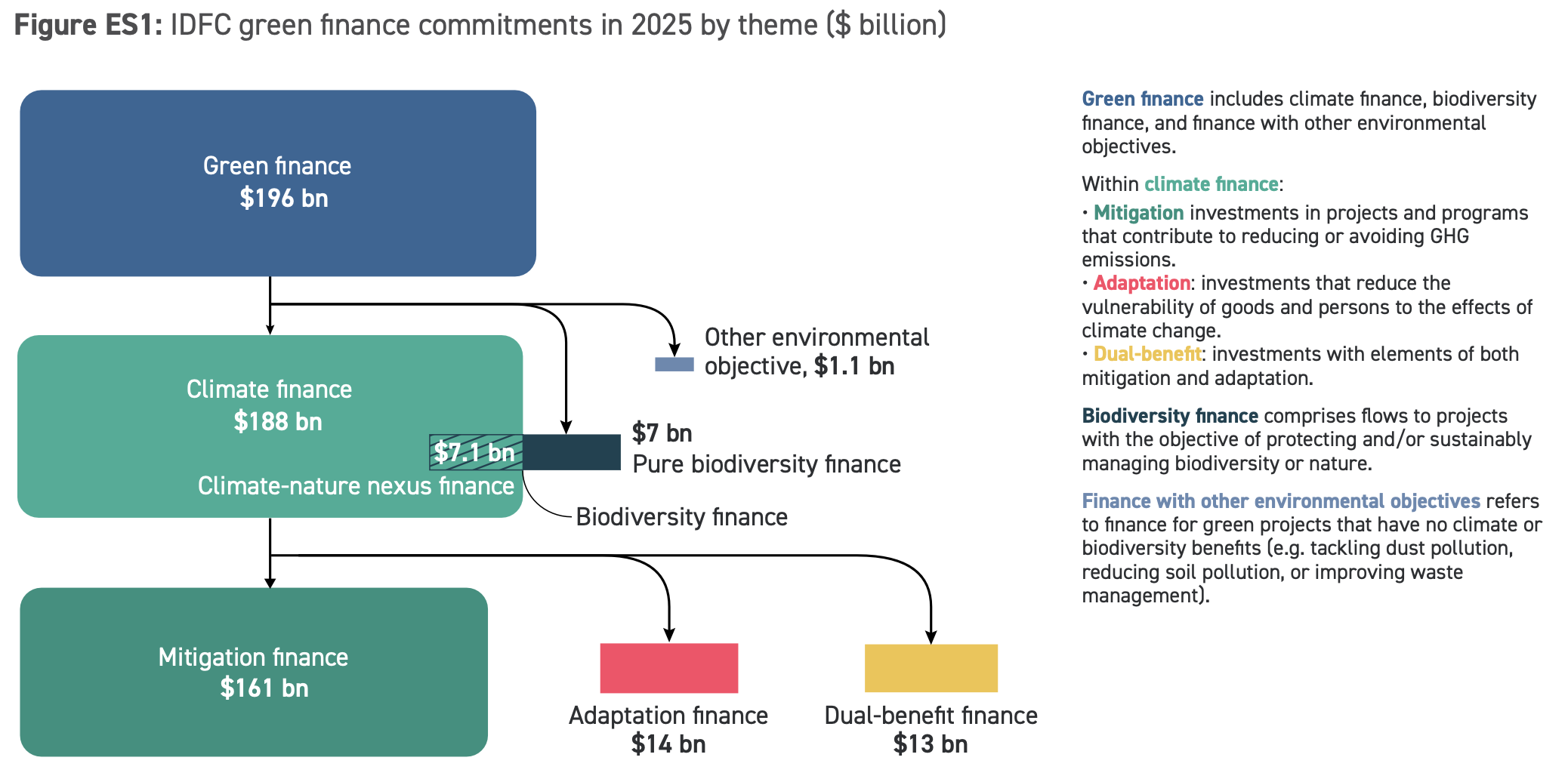
IDFC members committed USD196 billion in green finance in 2025, a 14% increase from 2024 following two consecutive years of decline. The recovery was broad-based, with 16 of 22 responding members reporting higher green finance commitments, up from. Green finance represented 16% of members’ total new commitments, compared with 13% in 2024 and an average of 19% over the preceding five years.
Note: Green finance includes climate finance, biodiversity finance, and finance with other environmental objectives
International climate finance rises to USD 40 billion as OECD-to-non-OECD flows double
IDFC members committed USD 40 billion in international climate finance in 2025, up from USD 27 billion in 2024. International commitments accounted for 21% of members’ climate finance, compared with 17% the previous year.
International climate finance from OECD-based institutions to non-OECD-based institutions doubled from USD 12 billion to USD 24 billion, representing 61% of the Club’s international climate finance commitments.
Overall, USD 138 billion (73%) of IDFC climate finance flowed to or within non-OECD countries in 2025.
Mitigation finance grows while combined adaptation and dual-benefit finance remains stable
Climate finance accounted for 96% of total green finance, reaching USD 188 billion in 2025. Mitigation finance increased 15% to USD 161 billion in 2025, representing 86% of climate finance. In contrast, adaptation finance fell 19% from USD 17 billion to USD 14 billion in 2025. The number of members reporting adaptation finance also declined for the second consecutive year, from 15 institutions in 2024 to 11 in 2025.
Dual-benefit finance, which delivers both mitigation and adaptation benefits, rose 41% to USD 13 billion. Combined adaptation and dual-benefit finance remained broadly stable at USD 27 billion, compared with USD 26 billion in 2024.
Biodiversity finance rebounds as members develop dedicated strategies
Biodiversity finance increased nearly 80%, from USD 8 billion in 2024 to USD 14.2 billion in 2025, reflecting higher commitments to conservation and projects involving agriculture and natural resource management.
Cumulative biodiversity commitments since 2022 reached USD 49 billion, against the IDFC’s ambition to mobilize USD 100 billion over five years by 2027.
While biodiversity tracking remains limited, IDFC’s Biodiversity Stocktake revealed that 12 members have adopted or are developing biodiversity strategies, which could support broader reporting and increased investment in future.
Climate finance remains concentrated in East Asia and the Pacific
East Asia and the Pacific remained the largest recipient region, accounting for 54% of IDFC members’ climate finance in 2025, down from 63% in 2024. Western Europe received 22%, followed by Latin America and the Caribbean at 13%. Climate finance commitments to Sub-Saharan Africa increased 15% to USD 6 billion. However, the region’s share remained at just 3% of total IDFC climate finance.
Four institutions drive majority of the annual increase
Four institutions — KfW, CDB, JICA and CAF — accounted for 91% of the year-on-year increase in green finance commitments. KfW alone contributed 55% of the increase, primarily through mitigation finance.
Growth was not limited to larger institutions. Africa Finance Corporation (AFC), almost doubled its commitments from USD 395 million to USD 755 million.
These results illustrate how changes in the portfolios and reporting practices of a few large institutions can influence overall green finance trends.
Sustaining momentum and closing the gaps
The 2025 results demonstrate the scale of IDFC members’ contribution to climate and environmental investment. Since 2019, members have mobilized USD 1.5 trillion in cumulative green finance, surpassing their pledge to mobilize USD 1.3 trillion over the period.
The findings also highlight where further progress is needed. Growth in dual-benefit finance is positive, but it cannot fully replace dedicated adaptation finance. More effort is needed to scale adaptation finance alongside the broader growth in dual-benefit finance. Cumulative biodiversity finance is below the Club’s USD100 billion commitment for 2027, and climate finance to Sub-Saharan Africa remains a small share of the total despite year-on-year growth.
Strengthening the consistency and transparency of green finance tracking will be important to understanding these trends and supporting future investment. Through its three-year capacity-building program (2023–2025), the IDFC Climate Facility, in partnership with CPI, has worked to improve the robustness and consistency of members’ reporting.
About the IDFC Green Finance Mapping
Established in 2011, the International Development Finance Club (IDFC) is a network of 27 national and regional development banks with more than USD 4 trillion in combined assets and annual commitments exceeding USD 1.2 trillion in 2025.
The annual IDFC Green Finance Mapping tracks members’ commitments across climate finance, biodiversity finance and other environmental objectives. Climate finance includes mitigation, adaptation and dual-benefit activities; biodiversity finance supports the conservation and sustainable management of nature; and other environmental finance covers projects without climate or biodiversity objectives.
The mapping provides an annual evidence base for understanding green finance flows, tracking progress and identifying areas where further investment and improved reporting are needed.
