

IDFC Green Finance Mapping 2026: Biodiversity Analysis
IDFC biodiversity finance rises to USD 14.2 billion in 2025, its highest level since 2022. A stocktake of progress against the IDFC Common Position Paper on Biodiversity (2022) shows that members are building biodiversity into their strategies, but cumulative finance remains well below the Club’s USD 100 billion commitment.
IDFC biodiversity finance at a glance:
- USD 14.2 billion: biodiversity finance in 2025, up 79% from 2024
- USD 49 billion: committed since 2022, under half the USD 100 billion target for 2027
- 7 of 7: members reporting biodiversity finance increased it in 2025
- 12 or 20: responding members have a biodiversity strategy in place or in development
- 15 of 20: responding members manage biodiversity risk at the project level
About the IDFC biodiversity analysis
The International Development Finance Club (IDFC) is a network of national and regional development banks. This is the sixth year its Green Finance Mapping has tracked biodiversity finance. It covers climate-nature nexus finance, which supports both climate and biodiversity objectives, and finance solely targeting biodiversity.
Biodiversity finance in 2025: key findings
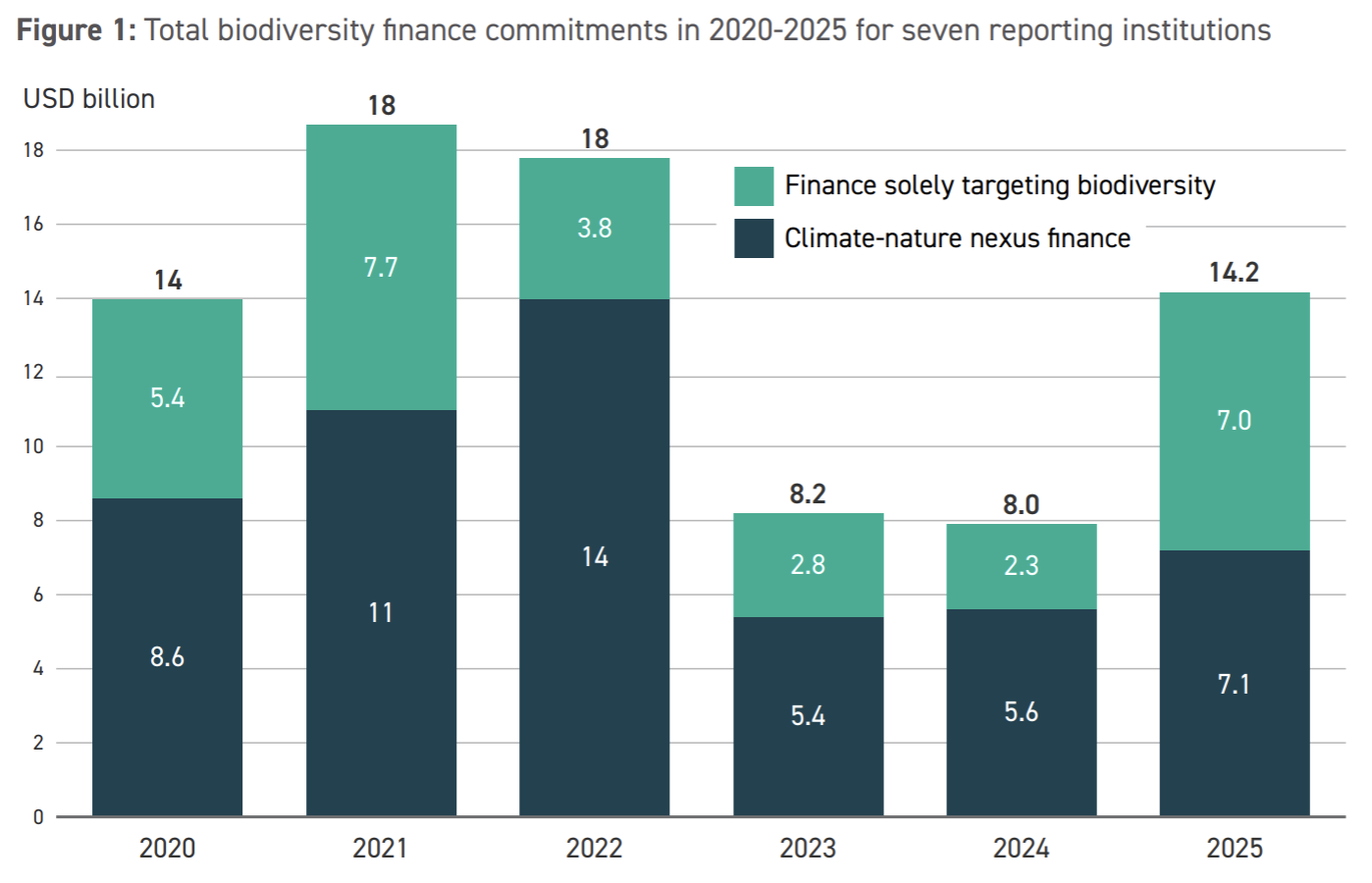
Biodiversity finance rose 7% to USD 14.2 billion
- Seven IDFC institutions reported biodiversity commitments of US$14.2 billion in 2025, an increase of US$6.2 billion on 2024. This is 7% of total green finance.
- A few institutions drive the increase. Commitments from China Development Bank (CDB) to activities solely targeting biodiversity, together with higher commitments from KfW and the Japan International Cooperation Agency (JICA), account for most of the growth.
- Commitments from OECD-based institutions tripled to USD 3.6 billion, reflecting significant increases in commitments from KfW and JICA, alongside consistent contributions from AFD.
Finance solely targeting biodiversity now matches climate-nature nexus finance
- Growth was concentrated in finance solely targeting biodiversity, which tripled from USD 2.3 billion in 2024 to USD 7 billion in 2025. Climate–nature nexus finance grew more modestly, by 27% from USD 5.6 billion to USD 7.1 billion. For the first time since tracking began in 2020, the two categories had equal share of 50%.
- This shift was primarily due to China Development Bank (CDB) which committed USD 6.2 billion to biodiversity-only activities in 2025, compared with USD 1 billion in climate-nature nexus finance. All other reporting members directed most of their biodiversity finance to activities with both climate and biodiversity objectives.
Socktake: strategies are growing, but quantified targets remain rare
In 2026, 20 of the 22 responding members also completed a stocktake survey on progress against IDFC’s Common Position Paper on Biodiversity (2022). Among 20 respondents that completed the stocktake survey:
- Seven members have a biodiversity or nature strategy in place and five more are in the process of developing one. Only four have set quantified targets.
- Fifteen members apply safeguards, due diligence or exclusions to manage biodiversity. Fewer have moved beyond avoiding harm to financing positive outcomes.
- Two members assess nature-related risk across their portfolios level, both cases where supervisory requirements apply.
- Members at all levels of maturity in their biodiversity strategies report the same constraints: lack of biodiversity data, bankable projects, technical capacity and client demand.
Cumulative biodiversity finance is under half of the 2027 target
Biodiversity finance reported by IDFC members remains well below the Club’s commitment to mobilize USD100 billion over five years by 2027, with cumulative commitments of USD 49 billion since 2022. Progress on strategies and operations has yet to translate into finance at the scale IDFC has committed to. Closing this gap will require both more members tracking and reporting biodiversity finance and a significant scale-up of dedicated investment.
How IDFC can scale up biodiversity finance
Moving from strategy development to implementation will require coordinated action in three areas:
Strengthen institutional capacity
- Seven members identify gaps in their own technical capacity, that of their clients, or both. Members could combine financing with technical assistance to strengthen environmental agencies and governments, whose weak capacity can constrain project development.
Translate strategies into measurable objectives
- Alongside finance targets, members could adopt indicators such as the share of portfolios screened for nature-related risks, the number of clients supported to develop biodiversity strategies, or the area of ecosystems protected or restored.
Expand financing instruments to attract private investment
- Ten members report no private finance mobilized for biodiversity to date, and existing instruments remain concentrated in grants and loans. Members could combine such instruments with project preparation, blended finance and partnerships that address the barriers limiting private investment.
The full IDFC Green Finance Mapping 2026 report, covering climate and other environmental finance alongside biodiversity, will be published on 6 November 2026.
