

Reducing methane emissions can slow near-term warming and help combat the climate crisis. Per unit of mass, the warming effects of this short-lived climate pollutant are 86 times stronger than CO2 over 20 years. Over 100 years, methane is 28 times stronger. Mitigating it is therefore critical to achieving the goals of the Paris Agreement and the Global Methane Pledge, signed by over 155 countries, to cut emissions by at least 30% below 2020 levels by 2030.
For Indonesia, methane offers a major opportunity to strengthen climate mitigation efforts, and waste is at the forefront of this challenge. Waste is the country’s largest source of methane emissions, accounting for 53% of the national total in 2022. This not only contributes to the climate crisis but also threatens community safety by increasing the risk of landslides and fires.
The link between methane and waste is clearest in municipal solid waste, where emissions depend largely on how cities manage organic waste. When food waste and other organic waste are poorly managed and end up in landfills, they decompose under oxygen-poor (anaerobic) conditions and generate methane. Reducing these emissions requires transforming the waste management system to keep organic waste out of landfills through waste prevention, source separation, and proper treatment.
Bandung offers a practical example of what this transformation could look like at the city level. As part of the Lowering Organic Waste Initiative (LOW-M), CPI and Bandung-based environmental non-profit Yaksa Pelestari Bumi Berkelanjutan (YPBB, or Guardian for Sustainable Earth) have co-developed a portfolio of interventions to enable Bandung to collect, divert, and treat 100% of its organic waste while creating value from treatment outputs. This portfolio was developed and validated in close collaboration with the Bandung City government, in response to a capacity crisis at the Sarimukti Landfill.
The 100% organic waste diversion mechanism was tested through GASLAH, a pilot project launched in January 2026, during which waste workers collected segregated organic waste from households and then applied various composting methods and technologies including black soldier fly (BSF). Figure 1 illustrates how this portfolio can create value by supporting urban farming and producing fruits and vegetables with the compost generated within the facility.
Figure 1. Value creation of organic waste treatment
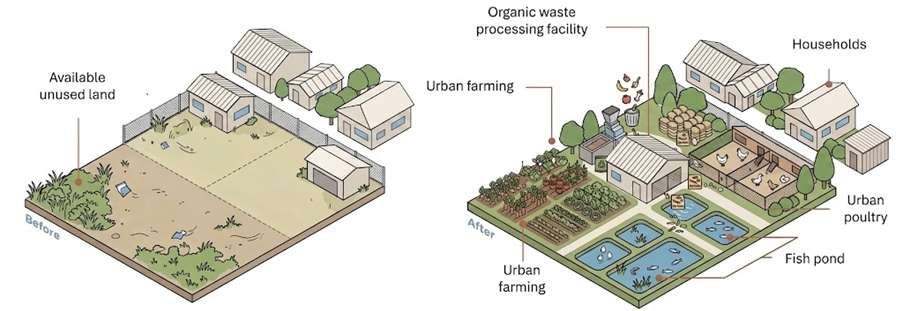
Source: CPI analysis, with illustration developed by generative AI
Bandung’s experience points to a broader consideration for other Indonesian cities facing similar waste crises: whether such a transition is affordable at scale. As municipal budgets for waste management are often constrained, solutions must be economically feasible and technically sound. Understanding the costs and benefits of different waste management models is critical to building a case for investment.
Organic Waste Diversion Offers a Low-Cost Alternative to Landfill
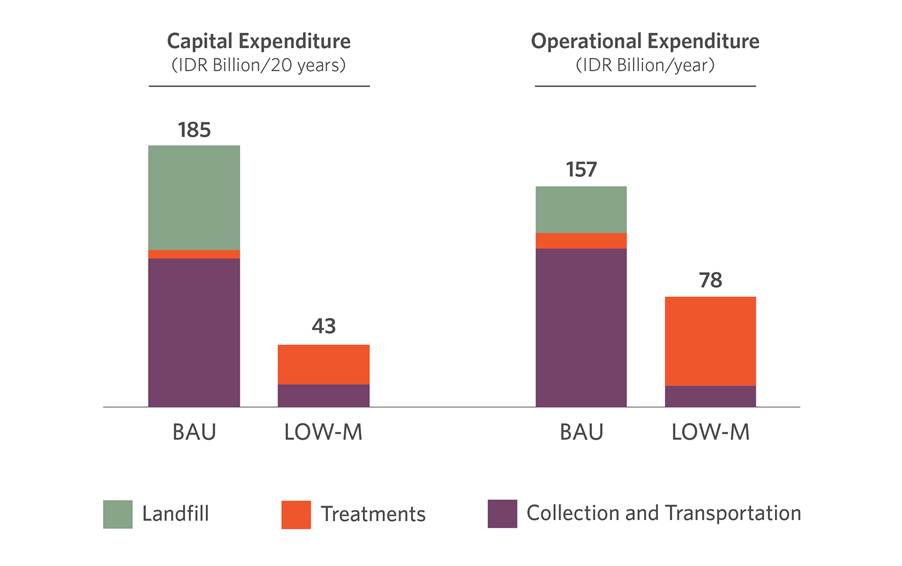
Organic waste accounts for around 41% (or 228,125 tons) of the total waste Bandung generates each year, based on data gathered by YPBB from Bandung City Government. By diverting this through decentralized organic waste management (OWM), Bandung could reduce capital expenditure by 76% and the operating expenses by 50% compared to its business-as-usual (BAU) waste management practices, cutting fuel costs by 82%.
Figure 2. Cost comparison between BAU and decentralized OWM
Source: CPI analysis
Lower transport costs could also reduce exposure to fuel price volatility. The BAU cost structure is driven by the system’s reliance on transportation and use of landfill, with limited waste treatment. By contrast, the decentralized OWM scenario eliminates the need to dispose of organic waste in landfills and shifts most expenditures to treatment. By treating organic waste closer to its source, the scenario also substantially lowers fuel costs. Moreover, wages and salaries account for 57% of total operating costs, highlighting the model’s potential to create green jobs, particularly in organic waste treatment. These employment benefits are further captured in the co-benefits calculation.
Identifying Co-Benefits
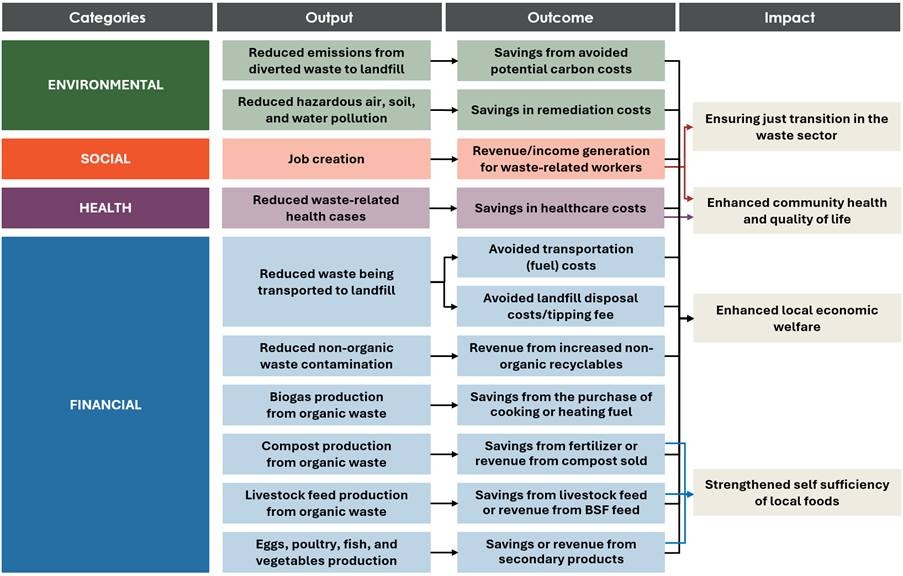
Decentralized OWM unlocks wider co-benefits beyond methane mitigation and cost savings from landfill diversion. By identifying and quantifying these co-benefits, local governments and financiers can consider the broader impacts and make more informed decisions when evaluating and investing in waste management projects. Figure 3 maps these co-benefits across four categories: environmental, social, health, and financial.
Figure 3. Co-benefits from decentralizing OWM, by category
Source: CPI analysis
Quantifying Co-Benefits
Identifying co-benefits is only the first step. To make them actionable for decision-makers, co-benefits need to be quantified and monetized. Table 1 shows the quantified co-benefits of decentralizing OWM, based on data from public-sources, local government agencies, and local partners, with some limitations on pollution and health data.
Table 1. Quantified co-benefits of decentralizing OWM in Bandung
| Co-benefits | Value | Unit |
|---|---|---|
| Environmental | ||
| Reduced methane emissions from diverting organic waste from landfill | 695.7* | tons of methane/year |
| Reduced CO2 emissions from fuel (as organic waste is no longer transported to landfill) | 1,155 | tCO2e/year |
| Social | ||
| Job creation | 1,733 | jobs/year |
| Financial | ||
| Reduced fuel consumption (as organic waste is no longer transported to landfill) | 427,734 | liters/year |
| Increased recyclables recovered without organic waste contamination | 86,870 | tons/year |
| Financial (Primary Products) | ||
| Compost (including BSF larvae frass)** | 42,811 | tons/year |
| BSF maggots for livestock feed | 27,831 | tons/year |
| Biogas | 171,094 | m3/year |
| Financial (Secondary Products) | ||
| Eggs | 1,426 | tons/year |
| Poultry | 396 | tons/year |
| Fish | 582 | tons/year |
| Vegetables | 1,468 | tons/year |
* Based on WasteMAP data of methane emissions at Sarimukti Landfill as of 3 June 2026
** BSF larvae frass is organic residue produced during the processing of organic waste by BSF larvae.
Selling primary and secondary products, including compost, livestock feed, biogas, animal- and crop-based products, and high-value recyclables, can generate additional revenue streams. These products can create direct economic value for offtakers, which can, in turn, improve access to finance.
Assessing Economic Viability: Cost-Benefit Analysis
A cost-benefit analysis (CBA) was conducted to estimate the monetary value of the project’s co-benefits, including revenue streams available to offtakers and cost savings. These were then compared against the costs over a defined period to determine the net value of decentralizing OWM.
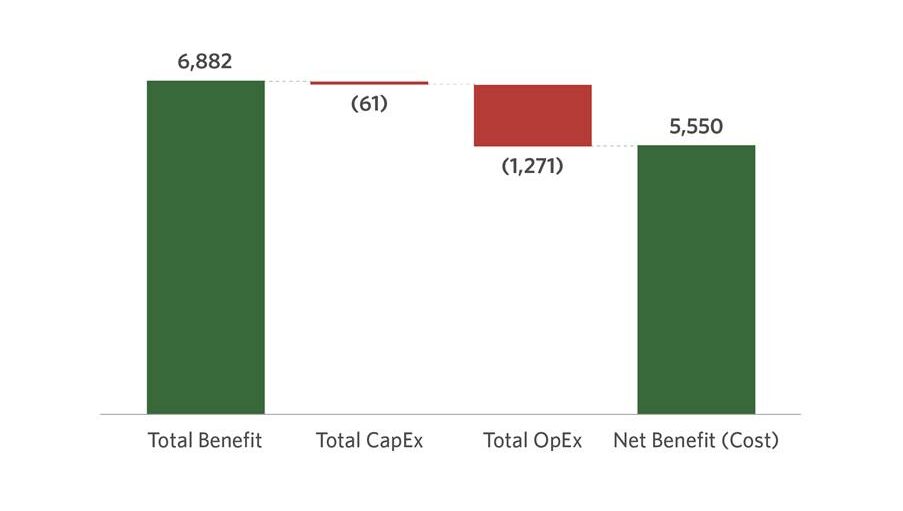
Under the decentralized OWM scenario, the results project an investment cost of IDR 60.92 billion (USD 3.38 million) and annual operating costs of IDR 63.54 billion (USD 3.53 million), including the production costs of primary and secondary products, over a 20-year horizon. These costs are expected to generate co-benefits worth IDR 344 billion (USD 19.12 million) per year, resulting in a net present value (NPV) of IDR 5.55 trillion (USD 308.33 million). The benefit-cost ratio (BCR) of this scenario is 5.17, meaning that every IDR 1 spent yields IDR 5.17 in benefits.
Figure 4. Net benefit of decentralizing OWM, 2026-2046, IDR bn
Source: CPI analysis
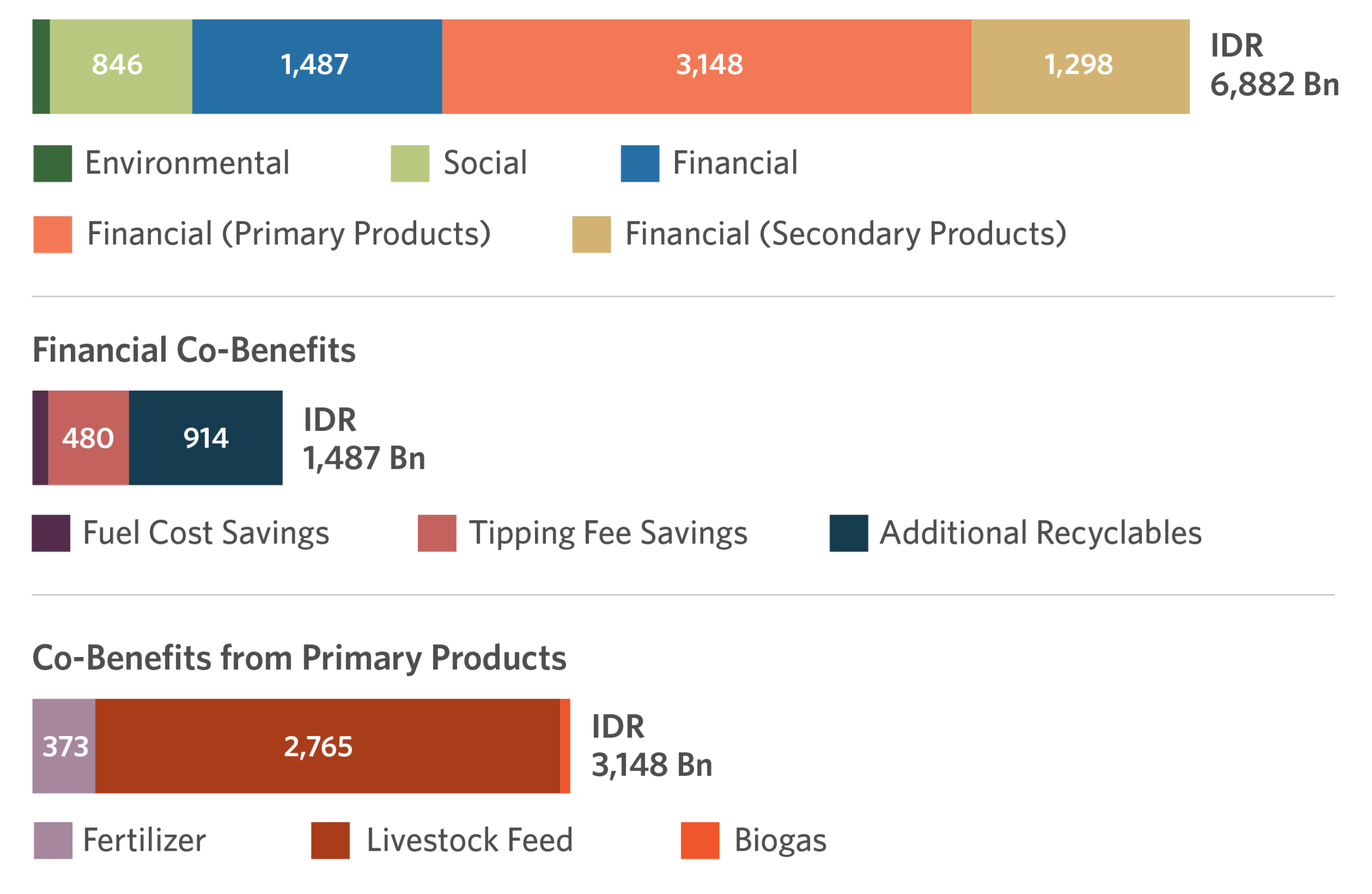
With a positive NPV and a BCR greater than 1, this scenario generates a net positive benefit and is therefore considered economically viable under the model’s assumptions. Financial benefits account for 86% of total co-benefits, underscoring a strong economic case for the proposed scenario. (see Figure 5). Within that, potential annual revenue streams include:
- IDR 157 billion from primary products, 88% from livestock feed;
- IDR 65 billion from secondary products, 33% from vegetables;
- IDR 46 billion from recyclables, such as high-value plastics.
The scenario also generates annual reductions in government expenditure:
- IDR 24 billion in savings from tipping fees by diverting organic waste from landfill;
- IDR 4.65 billion in fuel cost savings from reduced waste transport to landfill.
Figure 5. Co-benefits by category, 2026-2046, IDR bn
Source: CPI analysis
Mapping Where Value is Created
Co-benefits can also be traced through the waste management stages, from collection and transportation to treatment. Distinguishing co-benefits by stage is crucial to show where public investment should go to capture the largest share of value.
Figure 6. Identified co-benefits of decentralizing OWM in Bandung, by waste system
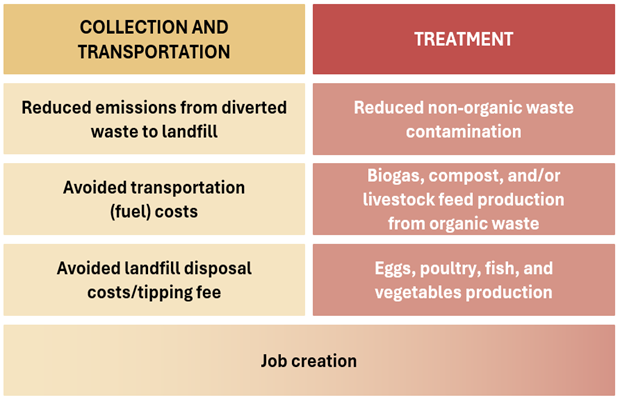
Waste treatment alone accounts for two-thirds of total waste management co-benefits. Since current regional budget (APBD) allocations remain weighted toward waste collection and transportation, local governments could reallocate public spending to waste treatment to improve local economic welfare, strengthen food security and reduce reliance on imports.
Figure 7. Quantified co-benefits by waste management process, 2026-2046, IDR bn

Source: CPI analysis
Financial institutions with ESG and public health interests could also consider financing waste treatment, as doing so could deliver a multiplier effect.
Recommendations
Learning from the Bandung case, stakeholders in Indonesia can consider the following actions to scale up investment in organic waste diversion and treatment:
- Provide accessible public funding to support municipal solid waste management programs.
- Integrate decentralized OWM into municipal planning and budgeting, including by reallocating spending on tipping fees and fuel costs toward organic waste diversion and treatment that can deliver environmental, health, social, and financial co-benefits.
- Encourage financial institutions that consider impacts in their investment decisions to recognize these co-benefits, rather than relying solely on direct financial returns.
- Incorporate environmental, health, social, and economic benefits into cost-benefit analysis, particularly for public service projects such as waste management, to better inform investment and financing decisions.
Bandung needs immediate action to address its waste management crisis. This analysis makes a stronger economic case for treating organic waste closer to source. Decentralized OWM offers a more cost-effective alternative to current landfill practices, reducing pressure on local government budgets while delivering a net positive economic return. With benefits estimated at around five times the costs, this approach can simultaneously reduce waste-related methane emissions, strengthen economic resilience and food security, and contribute to a just transition in the waste sector.
