

Tracking the Climate Transition of the Global Financial System: Insights from the Net Zero Finance Tracker
The global financial sector has made significant progress in responding to climate change, but momentum is stalling. Findings from the Net Zero Finance Tracker 2026 highlight a persistent gap between climate ambition and the investment decisions needed to deliver the net-zero transition.
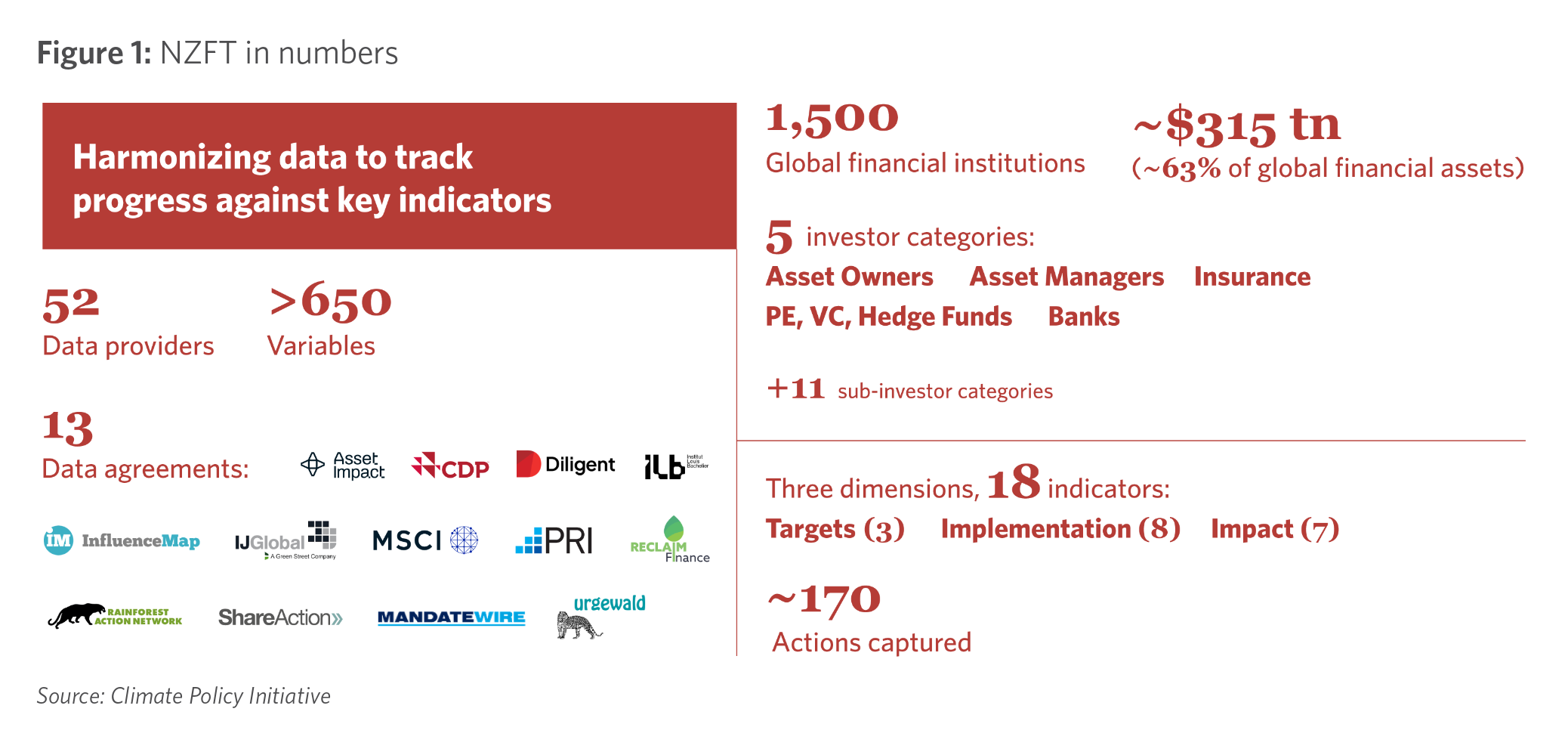
Drawing on an assessment of 1,500 of the world’s major financial institutions, the report examines progress across climate targets, implementation, and real-economy outcomes. It identifies where financial institutions are making meaningful advances, where challenges remain, and the actions needed to accelerate the transition.
Climate targets and implementation are losing momentum
For the first time since 2019, progress on climate targets and implementation among major financial institutions has stalled.
In 2025, financial institutions representing only around a quarter of assessed assets under management or ownership scored “Progressing” or above on climate targets, while institutions representing approximately two-fifths of assessed assets achieved this level on implementation.
Although climate risk management and governance practices have strengthened considerably, institutions continue to struggle to translate these capabilities into measurable changes in financing and corporate behavior.
Clean energy financing is accelerating, but fossil-fuel exposure remains significant
Clean energy and transition activities accounted for 71% of tracked direct energy project finance in 2025, reflecting growing investment in cleaner energy solutions.
However, this progress has yet to translate fully into existing investment portfolios. Clean energy represented just 23% of tracked energy portfolio exposure, while substantial fossil-fuel exposure remained linked to companies planning production expansion.
These findings highlight the need for financial institutions to move beyond increasing clean energy investment and address the transition pathways of companies already represented in their portfolios.
Portfolio alignment is improving, but emissions reductions remain off track
While estimated Scope 1 and 2 portfolio emissions declined by 7% in 2025 to 2.4 GtCO₂e, they remained well above the illustrative 1.5°C-aligned level of 1.7 GtCO₂e. Only 12.5% of financed emissions came from companies classified as “Aligned” or “Aligning”, highlighting the persistent gap between climate commitments and measurable decarbonization.
Portfolio alignment has improved, with 35% of assessed portfolio exposure invested in companies classified as Aligned or Aligning in 2025, up from 11% in 2020. However, progress remains limited in high-emitting sectors, with just 0.6% of assessed oil and gas portfolio exposure classified as “Aligned” or “Aligning”. These findings underscore the need for stronger transition plans, targeted engagement, and measurable emissions reductions.
Climate risks are intensifying across financial portfolios
The report highlights how financial risks shift under different global warming scenarios. Under a 1.5°C scenario, transition risks dominate modeled portfolio losses, particularly among companies that are not aligned with a low-carbon transition.
At 2°C, and especially 3°C, economy-wide physical climate impacts become the dominant source of modeled portfolio losses, underscoring the importance of an orderly transition alongside stronger adaptation and resilience measures.
Emerging markets face greater financing and resilience challenges
Emerging markets and developing economies (EMDEs) face slower growth in clean and transition project finance, weaker corporate climate alignment, and greater modeled physical climate vulnerability than advanced economies within the portfolios assessed.
High financing costs, currency risks, and institutional capacity constraints continue to limit investment where climate and development needs are greatest.
Addressing these barriers requires country-specific transition pathways, stronger project preparation, local-currency finance, and targeted public support to mobilize investment in decarbonization and resilience.
From climate commitments to measurable outcomes
Despite these challenges, the report finds that stronger climate practices are associated with better financing and real-economy outcomes.
Financial institutions with stronger targets, transition plans, implementation practices, and disclosure demonstrate more favorable financing and portfolio outcomes.
The findings reinforce the importance of moving beyond commitments and reporting toward credible transition plans that guide capital allocation, strengthen corporate engagement, and support measurable emissions reductions.
The next phase of the financial sector’s climate transition must focus on delivery.
The Global Report 2026 outlines recommendations for financial institutions, policymakers, and regulators to strengthen accountability, accelerate investment in climate solutions, and build resilience to growing climate risks.
Read the full report for insights on how the financial sector can translate climate ambition into meaningful impact.
