


Indonesia’s ambitious yet vital expansion of its electricity transmission infrastructure requires novel approaches to tap new pools of finance. State-owned electricity firm PLN’s Electricity Supply Business Plan (RUPTL) 2025–2034 targets approximately 47.76 thousand circuit kilometers of transmission lines and substations, requiring an estimated total investment of USD 24 billion. This expansion is critical to meet rising electricity demand, integrate renewable energy, improve grid reliability, and address Indonesia’s geographic challenges as an archipelagic nation.
However, PLN has limited ability to provide all of the funds needed to deliver those targets. To address this challenge, this report evaluates five project financing models that could enable greater private investment in the Indonesian grid. These include leasing, joint ventures (JVs), public-private partnerships (PPPs), infrastructure investment trusts (InvITs), and collective investment schemes for infrastructure (CIS-DINFRA).
Figure 1. Alternative project finance models
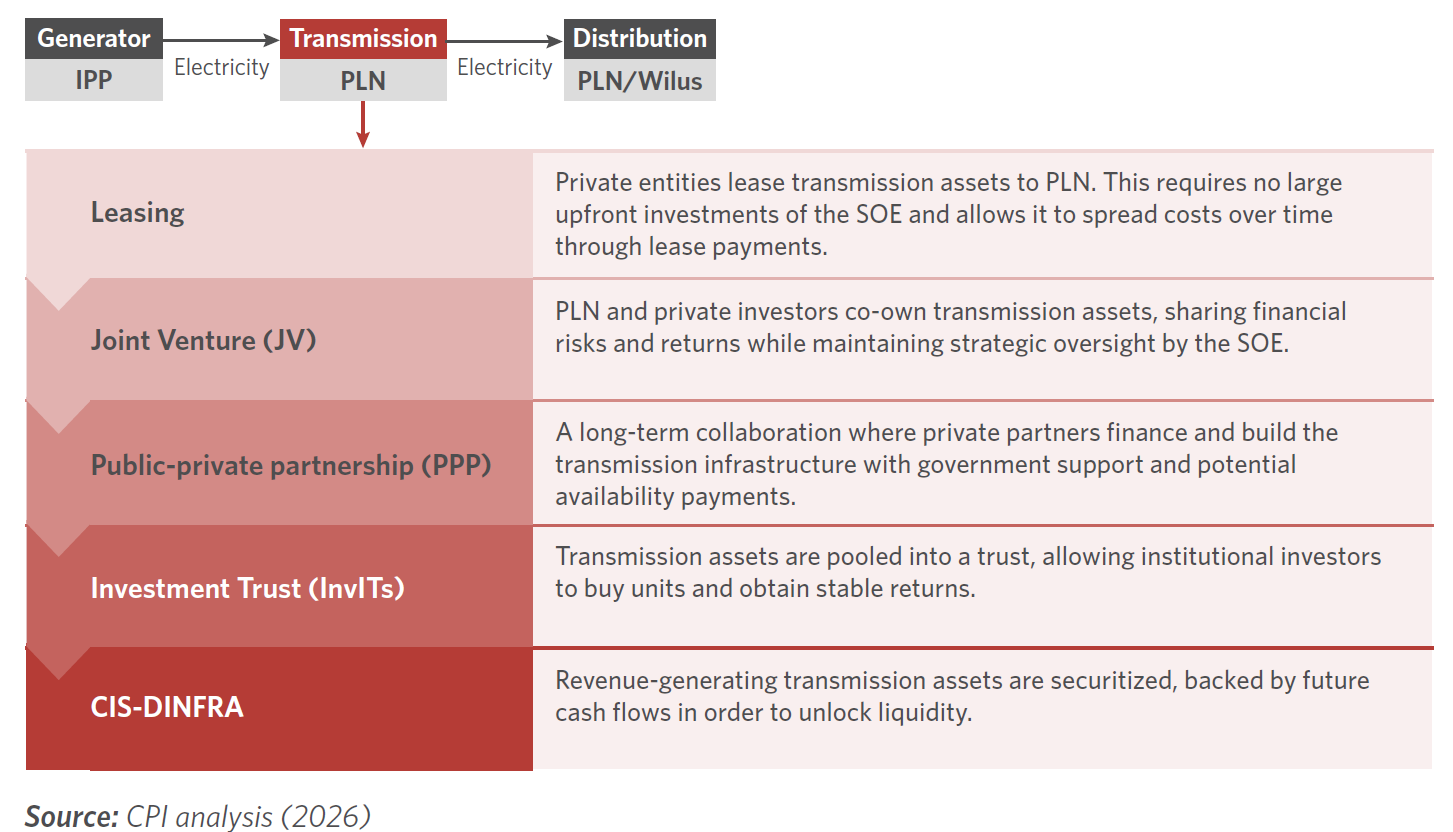
All of the proposed models shift financing from PLN’s current corporate-level finance models toward project finance structures. These structures rely on core project finance principles, including the use of special purpose vehicles (SPVs), non- or limited-recourse debt, and long-term revenue contracts, allowing risk sharing, improved access to capital, and enhanced financial sustainability for PLN.
Each financing model presents distinct benefits and trade-offs. InvITs and CIS-DINFRA are the most scalable and liquid options suitable for long-term capital mobilization and balance sheet optimization. PPPs offer a balanced approach with strong risk allocation but depend heavily on government support. Meanwhile, leasing and JVs are more practical for near-term implementation for projects with lower complexity.
To ensure successful implementation, all models require three foundational policy enablers as follow:
- A dedicated transmission fee to ensure predictable revenue streams,
- Off-balance sheet treatment similar to PLN’s treatment of Independent Power Producers (IPPs) to preserve PLN’s financial capacity, and
- Targeted fiscal support such as subsidies, guarantees, or availability payments to bridge gaps between regulated tariffs and investors’ return expectations.
The report further recommends that PLN prioritize regulatory engagement — particularly with the Financial Services Authority (OJK) — to enable off-balance-sheet treatment and develop supportive frameworks. In parallel, PLN should conduct market sounding to assess investors’ appetite, clarify institutional roles, and define clear criteria for selecting financing models aligned with its strategic objectives. These steps are essential to mobilize private capital effectively and ensure timely delivery of Indonesia’s transmission expansion goals, supporting both national electrification and the renewable energy integration.
