

The Battery Blind Spot in Indonesia’s Energy Transition
Indonesia’s transition away from coal to cleaner alternatives is progressing at pace—but the clean transition could have polluting side effects if the fuel cells sustaining it are not addressed. Battery circularity needs to be built into the country’s industrial and energy transition strategy from the outset, to ensure progress on climate is not accompanied by backsliding on waste.
More Indonesians are replacing internal combustion engine vehicles with electric vehicles (EVs), with a 49% increase in sales in 2025 despite a slowdown in the broader automotive market. In the first quarter of 2026, EVs accounted for nearly 15% of total vehicle sales, up from 8% during the same period in 2025. At the same time, renewable energy projects such as hydropower and solar are firing up across the archipelago, pushing the renewable share of the nation’s energy mix to 18%, ahead of the government target of 16.5% for 2026.
Behind this remarkable progress is a technology that is indispensable yet often overlooked in in terms of its own sustainability: the battery. Beyond powering EVs, batteries are increasingly being deployed in battery energy storage systems (BESS), which are integrated with solar and wind projects to store electricity and dispatch it when needed. Yet, as battery adoption accelerates, too little consideration has been given to what happens when these batteries reach the end of their useful lives.
This raises an urgent question: is Indonesia sustainably advancing its energy transition or simply creating a new wave of waste? Without proper planning, the country’s advances in reducing emissions may cause several steps back in the form of a growing legacy of battery waste.
Batteries: Could today’s solution become tomorrow’s problem?
As Indonesia accelerates its clean energy transition, it is also heading toward an inevitable surge in end-of-life battery waste. This is particularly concerning given the country’s ambition to become a global EV battery manufacturing hub, despite lacking a comprehensive domestic ecosystem for used battery collection, second-life applications, and large-scale recycling.
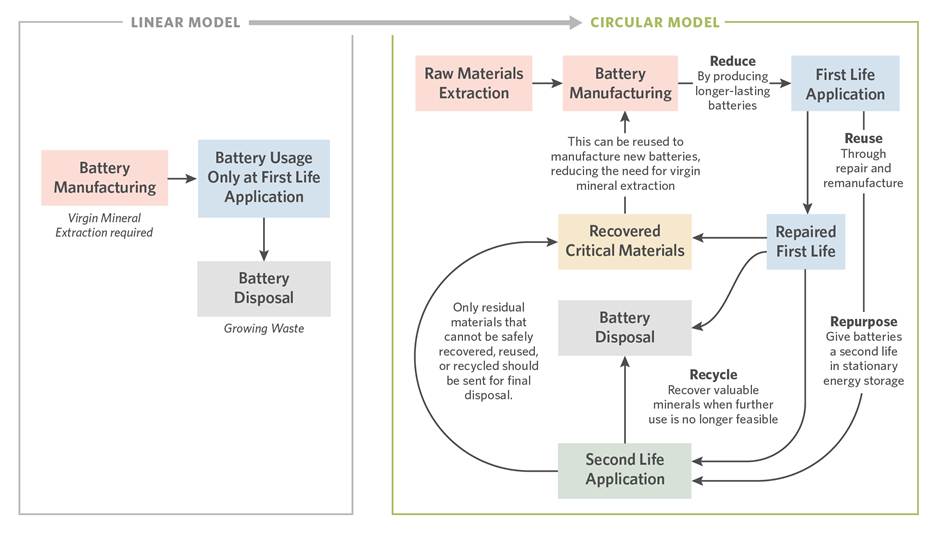
A truly sustainable energy transition should not follow a linear “produce-use-dispose” model. This model has a hidden cost, as every battery will require freshly mined critical minerals such as nickel, lithium, and cobalt. A circular model of the battery life cycle can reduce both waste and dependence on mineral extraction. This entails a circular value chain in which batteries are collected, repaired, or repurposed, and recycled to recover valuable material. If this model is not established before the first generation of depleted batteries, Indonesia risks swapping air pollution from fossil fuels for hazardous battery waste.
The challenge is more daunting than many realize. Most EVs in Indonesia use lithium-ion batteries whose lifespan depends on chemical components and usage. Typical electric motorcycle batteries in Indonesia are observed to last for just 1–3 years, with some higher-quality units reaching 3–5 years. Meanwhile, Indonesia utility‑scale BESS are typically conservatively modeled to operate for 10 years before requiring refurbishment or replacement. Given Indonesia’s EV adoption began in 2022, the country’s first wave of end-of-life batteries is expected to emerge before the end of this decade.
The implications extend well beyond waste management. At the community level, discarded EV batteries could enter Indonesia’s informal waste sector, where waste pickers may dismantle lithium-ion cells without adequate safety equipment, increasing exposure to toxic materials and fire hazards. More broadly, depleted batteries from utility-scale BESS could also become an environmental liability if left unmanaged.
Beyond Recycling: Closing the Loop on Battery Waste
Figure 1. Transitioning to a circular 4R battery lifecycle
Source: CPI analysis
A battery should reach the recycling stage only on its deathbed. Battery waste management should follow the same hierarchy as the broader circular economy: Reduce, Reuse, Repurpose, and Recycle (4Rs). In this order, recycling is the final option—not the default—after every practical use has been exhausted.
Starting with Reduce, governments could incentivize manufacturers to develop batteries with longer lifespans, slower degradation rates, and more durable designs — thereby cutting the number of batteries needed in the system. Reuse provides a pathway for batteries with repairable defects to be remanufactured wherever technically and economically feasible, minimizing premature disposal.
Repurpose could then be a defining step in managing the first wave of retired EV batteries. A battery removed from an EV is not necessarily at the end of its useful life. Batteries that no longer meet EV performance requirements may still retain around 70–80% of their original capacity, sufficient for stationary applications. Rather than recycling these batteries, Indonesia could repurpose them as BESS supporting solar-powered microgrids and rural electrification. This would extend battery life, delay waste generation, reduce demand for newly mined minerals, and extract greater economic value. 4R Energy, a joint venture between Nissan Motor and Sumitomo Corporation, demonstrated this in 2013 by launching the world’s first BESS using repurposed EV lithium-ion batteries in Yumeshima Island, Japan. Building on this success, the company deployed a second-life battery system on Koshikishima Island in 2015, which continues to support solar-and-wind microgrids and power EV charging stations to this day.
As every battery eventually reaches the point where recycling is unavoidable, valuable critical minerals can be recovered through chemical and metallurgical processes. While this is more sustainable and resource-efficient than extracting new minerals, Indonesia’s policy discussion often begins and ends here. Indonesia Morowali Industrial Park (IMIP) and the Indonesia Green Industrial Park (IGIP) have received major financing from global partnerships to integrate battery recycling and green nickel production as part of Indonesia’s nickel downstreaming project. While expanding recycling capacity is important, recycling facilities alone cannot solve the problem.
The greater challenge is not recycling feasibility but building an integrated system to collecting, transporting, sorting, and processing end-of-life batteries safely and economically. As some components will remain unrecoverable and should never enter ordinary municipal waste streams, Indonesia needs dedicated hazardous waste disposal facilities to prevent fires, toxic leakage, and environmental contamination. This aligns with global best practices, such as the European Union’s Battery Regulation (EU) 2023/1542, which establishes responsibilities across the entire battery value chain, from design and production to collection and end-of-life management. It emphasizes durability, repairability, and ease of disassembly to facilitate reuse, extend battery life, and reduce waste.
Indonesia’s downstreaming ambitions will have limited positive impact if they extend mining, rather than moving away from it. Batteries do not need to come from endless extraction, and they do not need to be hastily disposed. From the first battery manufactured to the last battery retired, this demands far more than a robust recycling industry. It requires an integrated battery ecosystem that generates less waste in the first place, maximizes batteries’ useful life and ensures every battery is managed responsibly until its final disposal.
