


Catalyzing Centre of Excellence for Energy Transition – A Strategic Enabler for Andhra Pradesh to Achieve Energy Transition Goals
India’s power sector is undergoing a transition driven by its ambitious targets. India has committed to achieving net zero emissions by 2070. In alignment with this net zero target, the country’s latest Nationally Determined Contribution aims to achieve 60% (638 GW) cumulative electric power installed capacity from non-fossil-fuel-based energy resources by 2035 and to reduce the emissions intensity of its gross domestic product (GDP) by 47% from the 2005 level (PIB 2026).
To align with the national ambition, Andhra Pradesh has set a target to achieve net-zero by 2047. AP has set ambitious clean energy targets, requiring coordinated planning among state actors and industry stakeholders and enhancing utilities’ technical capabilities. To develop an enabling environment, Andhra Pradesh Power Utilities has jointly established a Center of Excellence for Energy Transition (CoE-ET). The blog examines this institution’s need and suitability for AP and the complete southern region.
Energy Profile in Andhra Pradesh
The southeastern state of Andhra Pradesh has a vast, mixed renewable energy (RE) potential of 237 GW and could become a frontrunner in large-scale deployment (DoE AP 2024). Renewable sources already account for 50.5% (15.98 GW) of the state’s installed capacity (NITI Aayog 2026). Solar installations accounted for 7.5 GW, wind for 4.4 GW, and the remaining 4.07 GW came from hydro and biomass as of March 2026 (MNRE 2026).
Andhra Pradesh has adopted a progressive policy framework to increase its RE resources, including the Integrated Clean Energy Policy 2024 (DoE AP 2024), which aims for:
- Installation of 78.5 GW of solar and 35 GW of wind capacity between 2024 and 2029.
- Addition of 25 GWh of battery energy storage systems (BESS) and 22 GW of pumped storage hydropower.
- Addition of green hydrogen production capacity of 1.5 MTPA.
Meeting these targets is crucial for Andhra Pradesh, as it has several electricity-intensive industries, including pharmaceuticals, food processing, and data centers. Increasing RE penetration and producing low-cost electricity from RE would promote industrial expansion, support energy security, and enable a clean energy transition.
Opportunities for Andhra Pradesh
In addition, renewable energy projects in remote areas would drive infrastructure development, job opportunities, and local economic development. Furthermore, integrating RE with BESS would help Andhra Pradesh utilities (including APEPDCL, APCPDCL, APSPDCL, APTRANSCO, and APGENCO) reduce procurement costs, participate in ancillary services and energy markets, and explore new revenue streams. These benefits are realized by leveraging a robust enabling ecosystem comprising supportive policies and regulations, strategic investments, technological innovation, and a skilled workforce.
Complexities in Achieving Energy Transition
Despite a strong focus and enabling environment, large-scale deployment of RE presents technical, financial, policy, and regulatory complexities. The variable and intermittent generation patterns from RE sources pose challenges for grid stability, power quality, forecasting & scheduling, and, consequently, curtailment issues for developers. At the same time, connectivity-related issues and transmission constraints could limit evacuation and grid integration, leading to uncommissioned RE projects. The transition also requires significant capital investments across the sector. For instance, Andhra Pradesh would require from INR 5.76 billion to INR 6.15 billion (USD 66 million to USD 71 million)[1] to install its targeted 114 GW of RE capacity (CEA 2026), with additional investment required for transmission and grid-stabilization infrastructure.
Centre of Excellence for Energy Transition
To rise to these challenges, the state needs to demonstrate readiness for execution and system preparedness. AP power utilities have thus jointly established a Centre of Excellence for Energy Transition (CoE-ET) to build the technical workforce’s capacity, incubate new business models and technology solutions, and produce a future-ready workforce. This CoE is envisioned to strengthen collaboration across stakeholders, including utilities, industry partners, academia, and research institutions. Its approach will be anchored across the key strategic areas shown in Figure 1 and described below.
Figure 1 Key strategic areas for AP CoE-ET
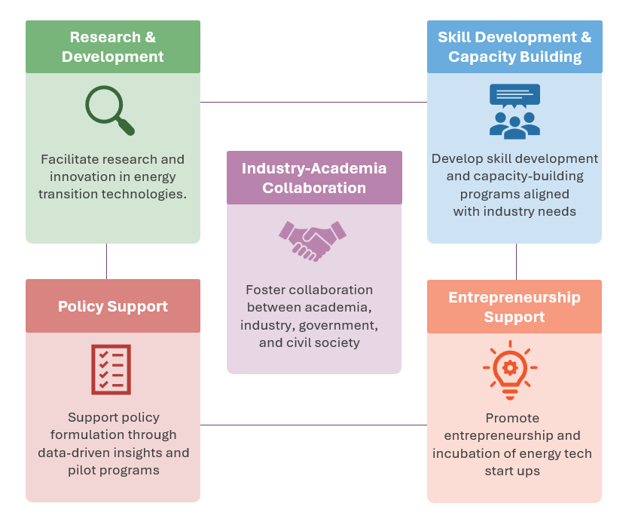
The CoE will cater to the technical and training requirements of AP discoms, APGENCO, and APTRANSCO. The CoE has planned its near-term goals to conduct research, provide training to more than 1000 utility professionals, and incubate more than 10 startups across the next five years, from 2025 to 2030 (GoAP 2025). A holistic approach is needed to develop the future transition pathways such that the transition aligns with the state’s development aspirations.
Research and Development
The CoE has collaborated with stakeholders from industry, academia, research organizations, and think tanks to conduct research and generate data-driven insights across various domains. This includes RE integration, distributed RE capacity enhancement, grid management, and the adoption of related clean technologies, such as electric vehicles, green hydrogen, and industrial decarbonization solutions. The research outcomes would generate actionable insights for utilities, policymakers, regulators, and other stakeholders while recognizing the domains that require innovation. In addition, this would help utilities assess their readiness and risk preparedness for advancing the transition.
Skill Development and Capacity Building
To enable a seamless transition, it is necessary to identify the utilities’ knowledge development needs for upskilling. These assessments could help utilities identify the domains where skills enhancement is required, resulting in a competent workforce that will actively partner in the transition. To do this, with support from academia and/or think tanks, the CoE would develop comprehensive training programs for utility professionals to build their technical skills and support informed decision-making.
Entrepreneurship Support
Resolving various technical barriers requires research and innovation, the integration of advanced systems, and data management. Over the next five years, CoE would support cohorts to incubate startups that specifically address these challenges, thereby accelerating the adoption of new technologies, improved data management, and enhanced business models, leading to grid modernization and optimal operation.
Policy Support
Long-term strategies are critical for a meaningful state-led transition. Achieving this requires proactive policy development and robust regulatory frameworks that address the critical bottlenecks hindering the energy transition. CoE will play a pivotal role in supporting the development of forward-looking policies and regulatory frameworks informed by global and sub-national best practices and data-driven insights.
Industry-Academia Partnership
Strategic partnerships between industry players and academia will serve as a bridge for driving research & development, skill development & capacity building, entrepreneurship, and informed policymaking. This would equip the state with a comprehensive, multidimensional approach essential for driving a holistic energy transition.
Progress to Date and Ongoing Initiatives
The CoE-ET has started delivering the outputs. To support startups and its own objectives, the CoE-ET organized a Hackathon at its Visakhapatnam centre in December 2025. The event brought together start-ups and innovators to address the changing needs of the power sector, including predictive maintenance through grid intelligence, artificial intelligence (AI) for transformer health, and computer vision for monitoring high-tension insulators.
Further, CoE-ET has organized training programs to build the capacity of its members, covering topics such as Battery Energy Storage Systems (BESS), Organizational Behavior, and People Management, to enhance utility professionals’ technical knowledge, creative leadership, and strategic decision-making.
Way forward for the CoE-ET
The state already has certain strategic advantages, such as its coastal location, which gives it an edge in trade; availability of land at lower lease rates; waivers for RE generation projects; and capital subsidies for solar, wind, green hydrogen, and storage manufacturing facilities. Establishing the CoE-ET could leverage these advantages and achieve meaningful outcomes across economic, infrastructure, and social domains. In addition, CoE-ET would help strengthen the utilities’ operational capabilities by identifying needs and supporting the ecosystem in exploring technology solutions to improve grid flexibility, enhance forecasting systems, and enable advanced control systems. It would foster the adoption of emerging technologies and facilitate improved system planning and risk management. Most importantly, it would provide a collaborative platform for utilities and other stakeholders to plan strategically and address sectoral complexities. Collectively, this will help Andhra Pradesh to emerge as a proactive leader—translating its strength in RE policy into implementation for its energy transition.
As Andhra Pradesh progresses on this journey, understanding and addressing underlying complexities will be critical. In an upcoming blog series, CPI, along with CoE-ET, explores these complexities in depth and potential mitigation solutions.
[1] Conversion rate used is USD = INR 87
