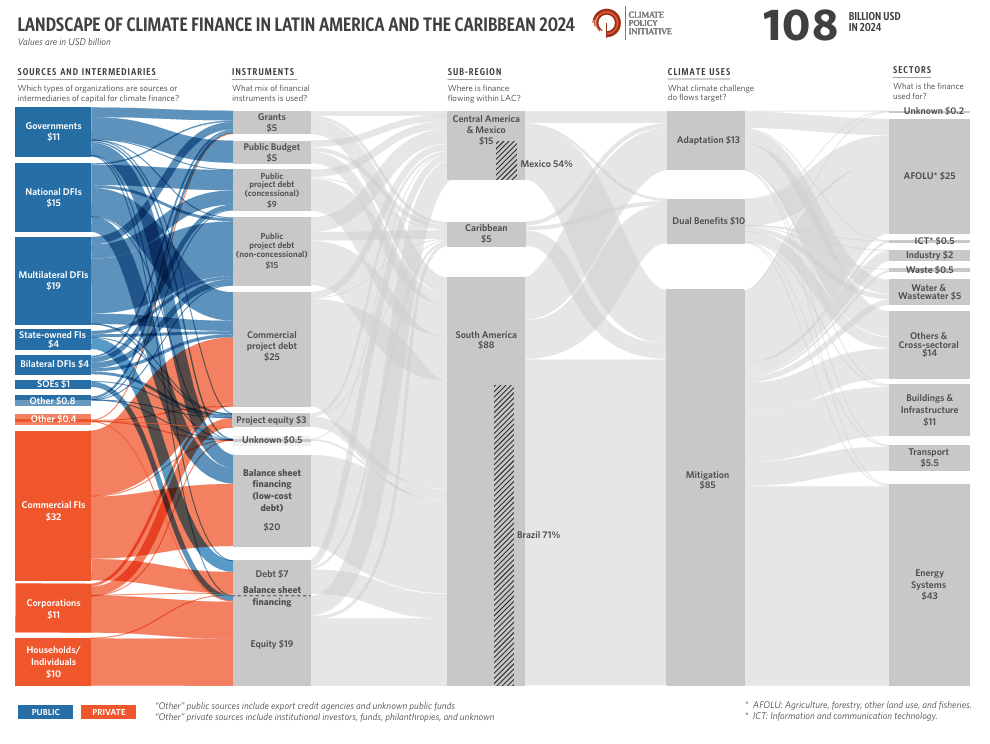
Latin America and the Caribbean (LAC) has significant climate investment opportunities and some relatively mature markets, but climate finance remains far below needs and highly uneven across countries, sectors, and climate objectives. Brazil, Mexico, and several larger South American economies have deeper capital markets and larger project pipelines than other countries in the region, along with significant opportunities in renewable energy, industry, and land use. By contrast, other Caribbean, Central and South American countries face smaller markets, high exposure to climate shocks, greater dependence on imported fuels and more constrained fiscal space. The region also has a distinct emissions profile: AFOLU is particularly important in major South American countries, while energy and transport are more prominent in many smaller Caribbean and Central American economies. These differences make granular, subregion- and country-specific analysis essential.
This first Landscape of Climate Finance in Latin America and the Caribbean provides a comprehensive stocktake of climate finance—public and private; domestic and international— flowing in and to the region from 2020 to 2024. It tracks investments across mitigation, adaptation, and dual-benefit activities, mapping flows from sources and financial instruments through to the sectors being financed on the ground. In doing so, it spotlights trends and opportunities, while teasing out key gaps and challenges in the LAC region. Disaggregated subregional analysis adds nuance across the subregions—the Caribbean, Central America and South America—with Brazil and Mexico separated as outliers because of their outsized climate finance flows.
KEY NUMBERS AND TAKEAWAYS
USD 108 billion of climate finance flowed in LAC in 2024.
Climate finance in LAC has doubled since 2020, but momentum has plateaued. Tracked flows rose from USD 54 billion in 2020 to USD 108 billion in 2024, however, investment in 2024 remained broadly unchanged from 2023, at USD 110 billion. Brazil accounted for over half of LAC flows, with a CAGR of 28% since 2020 driven by a boom in solar installations and climate-aligned agriculture. The rest of the region grew more modestly and from a lower base.
4-8X is the magnitude of the climate finance gap in LAC, comparing flows to estimated needs (2025-2030).
With annual mitigation finance needs in LAC estimated at between USD 467-847 billion, tracked climate finance flows fell short of estimated (modelled) needs by a factor of four in the low-end scenario, five on average, and widening to almost eight under the higher estimate. These estimates derive from climate scenarios and transition pathways rather than countries’ stated financing needs. On a sectoral basis, the estimated climate finance gap in LAC is highest in industry (26X current flows), followed by transport (25X), and AFOLU (over 7X regionally, rising to 125X once Brazil’s large AFOLU numbers are excluded from the calculation).
USD 95 billion of fossil fuel investment flowed in LAC in 2024.
Continued fossil fuel investment risks undermining climate progress. At around USD 95 billion, fossil fuel investment was more than double the USD 43 billion in climate finance tracked for energy systems. Redirecting existing capital is as critical as mobilizing new resources for the climate transition. The benefits of climate action far outweigh its costs: modeled co-benefits across all sectors (including fuel cost savings, improved productivity, the provision of ecosystem services, and the avoidance of pollution and associated positive health outcomes) exceed USD 15 trillion to 2050, or roughly USD 577 billion a year—more than five times the tracked climate finance in 2024.
58% of tracked flows were concentrated in Brazil in 2024.
Climate finance remains highly concentrated in Brazil, even after accounting for economic size. The country’s climate finance was equivalent to 2.9% of GDP and close to USD 300 per capita— nearly twice the regional average. The Caribbean, which accounted for 5% of the regional total, ranked second relative to GDP (2.2%), boosted by concessional inflows and an expanding solar market in the Dominican Republic. Despite accounting for a higher individual share of the regional total (7%), Mexico placed lower in relative terms—climate finance was equivalent to only 0.4% of GDP and USD 61 per capita—despite its relatively more mature financial markets in the region.
~69% of tracked climate finance in LAC was from domestic sources in 2023/24.
Domestic capital forms the backbone of climate flows in LAC’s deeper financial markets, and is gaining ground elsewhere. Domestic sources dominated in Brazil (90%) and Mexico (64%), while international finance had a 40–60% share in other LAC subregions. However, Central America (excl. Mexico) showed a notable shift, where the domestic share of climate flows rose from 10% in 2021/22 to 35% in 2023/24. Scaling domestic capital is important because it can provide local-currency financing, better align investment with national priorities, and reduce dependence on official development assistance (ODA).
60–84% of climate finance was public, outside Brazil, Mexico, and Chile, in 2023/24.
Private capital leads only in LAC’s most mature markets, while public climate finance dominates elsewhere. Public actors provide 60–84% of climate flows outside Brazil, Mexico, and Chile—including in large economies such as Peru, Colombia, and Argentina. Mobilizing private investment remains constrained by smaller market size, high perceived risk (often exceeding actual risk), and the limited or uncertain revenue streams associated with many adaptation investments.
11% of climate finance in LAC was for adaptation in 2023/24.
Adaptation finance remains minimal relative to the region’s exposure and vulnerability to climate hazards. Mitigation absorbed between roughly 65–80% of tracked climate finance in every subregion, reaching USD 85 billion in 2024 and more than doubling since 2020, while adaptation grew slower (increasing only 56% over the same period), up to USD 12.5 billion by 2023/24.
~39% of climate finance in LAC was provided as non-concessional debt in 2023/24.
Non-concessional debt lending is the most prevalent instrument for financing climate action in LAC. More mature and commercially viable sectors – largely renewable energy systems as well as low-carbon transport and buildings & infrastructure – absorbed the bulk of this nonconcessional debt lending. Grants and concessional debt accounted for only around 11% of climate finance in most of subregions. Therein, Brazil was an outlier, with 45% in concessional debt, largely from subsidized rural credit. Central America (excluding Mexico) also received a higher concessional share at 23%. Concessionality should be calibrated to market conditions, providing better terms in structurally constrained markets and using mobilization-oriented instruments where private capital can readily be crowded-in.