


Making nature investable through agrifood systems
Nature-positive agrifood systems are gaining momentum as a pathway to support value chain resilience, but capital deployment remains a challenge. Under the Kunming-Montreal Global Biodiversity Framework, countries have committed to protecting 30% of land and oceans and mobilizing at least USD 200 billion annually for biodiversity by 2030. Multilateral development banks have introduced common principles for tracking nature finance, while 733 organizations, including asset managers overseeing USD 22.4 trillion, have committed to TNFD-aligned reporting ahead of COP30. These frameworks improve visibility and consistency, but they do not by themselves show investors which ecological outcomes to target, where opportunities lie, or how those outcomes can support an investment case.
Scaling finance for nature-positive investment needs measurable, investment-ready outcomes. One of the biggest barriers to this is developing measurement approaches that are relevant across different contexts. Unlike carbon, which can be expressed in a single unit (i.e., tons of CO₂e), measuring nature-related outcomes requires capturing multiple ecological dimensions that are hyper-localized. Biodiversity alone can be understood at three levels: genetic, species, and ecosystem diversity, each carrying its own measurement needs and costs.
Ecological conditions also vary significantly across regions and production models, so a metric that holds in one place misleads in another. In an agroecological coffee landscape, for example, functional biodiversity approaches may track pollinators and pest-control species, while structural biodiversity may assess crop varieties and forest connectivity, each shaped by local ecology and management practices, creating significant complexity. This complexity requires investors to adopt approaches tailored to geography, sector, and investment type.
CLIC members are using leading fit-for-purpose approaches to nature measurement that balance accuracy, cost, and scalability in ways that reflect different investment contexts. Our recent Nature Finance Action Group discussion highlighted several examples:
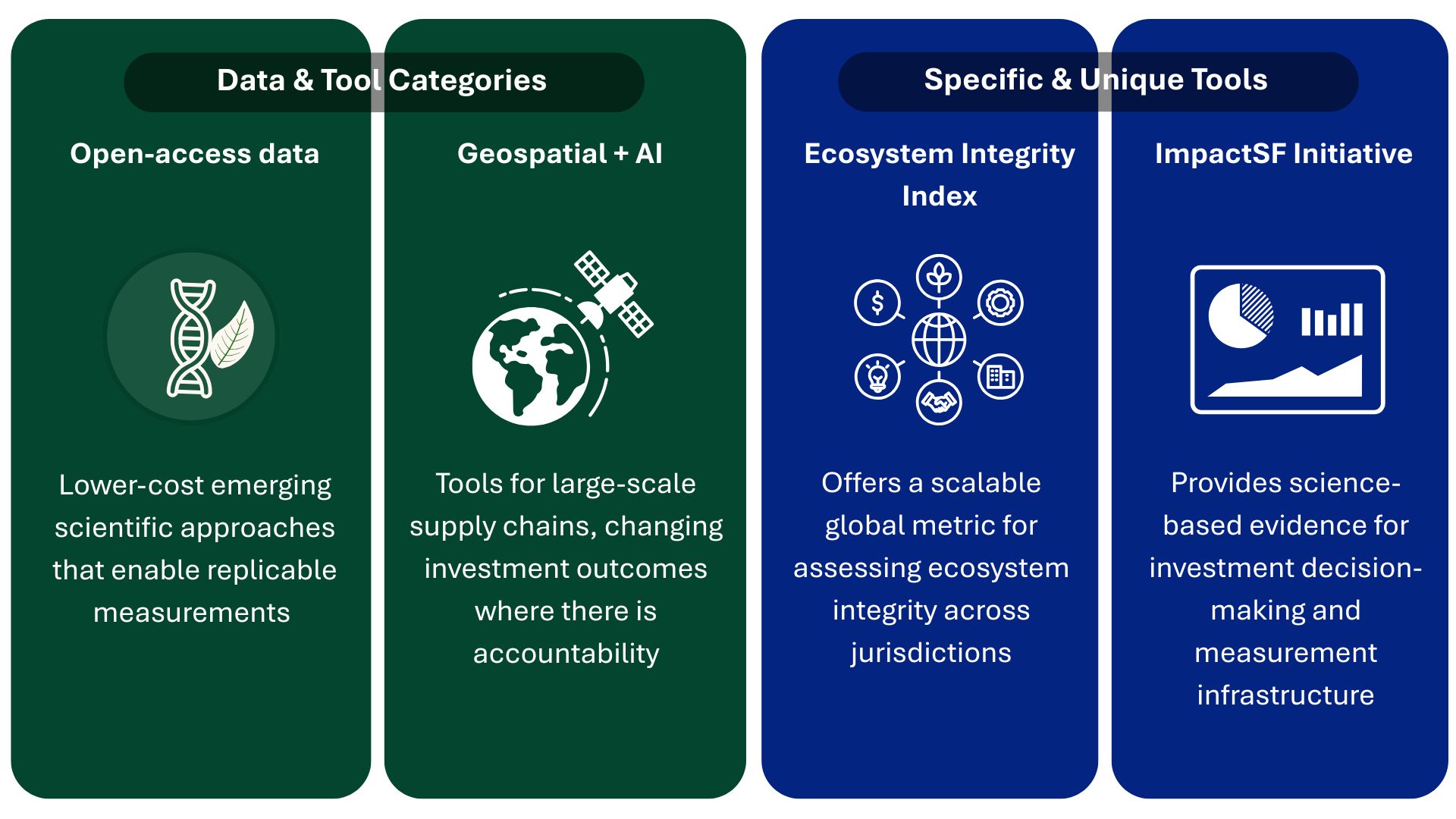
1. Open-access data: These emerging scientific approaches, such as eDNA, enable replicable measurements at lower cost.
2. Geospatial data and AI: These tools are becoming central for large-scale supply chains, though they only change investment outcomes where someone in the process is accountable for acting on what they show.
3. The Ecosystem Integrity Index: Developed by the UN and implemented by a specialist ecosystem-data organization, the Index offers a scalable global metric for assessing ecosystem integrity across jurisdictions, providing the kind of portfolio-level view that investors need.
4. ImpactSF initiative: This approach provides science-based evidence for investment decision-making, functioning as a measurement infrastructure for funds like Impact Earth’s Tropical Resilience Fund.
Rather than pursuing universal applications, members are designing their tools to match the use case. Greater standardization around such approaches would reduce costs and improve comparability and scalability, while allowing flexibility.
Agrifood systems can be a proving ground for nature-related investments because they are already demonstrating how ecological outcomes can be translated into commercial value. Value chains already face material commercial pressures linked to soil degradation, water stress, sourcing reliability, and long-term land productivity.
While measurement is necessary, nature on its own does not usually generate cash flows. Converting that ecological value into returns requires a willing payer and contracts that turn public benefit into contractual revenue. Although these mechanisms are nascent and scarce across most nature interventions, they are among the most advanced in agrifood systems. Practices such as regenerative agriculture, precision farming, and supply-chain optimization improve commercial performance directly through stronger yield stability, reduced fertilizer and pesticide use, lower input costs, improved water efficiency, and provide greater resilience to climate and supply-chain disruption. As a result, improvements in ecosystem condition show up in operational resilience and commodity cash flows.
The ability to translate ecological improvements into investment returns is further strengthened by market mechanisms that connect nature outcomes to commercial revenues. Voluntary demand, regulatory pressure, and existing commercial relationships increase market confidence and investor uptake. Biodiversity net gain frameworks, deforestation-linked regulation, sustainability-linked lending, and voluntary carbon markets tied to land-use practices each help create links from ecological outcomes to revenues. CPI’s Toolbox on Financing Nature-Based Solutions sets out how mechanisms like these have been structured in practice across 12 cases, and discusses the key role of public actors in creating an enabling environment to support the growth of innovative nature finance approaches.
One of the strongest signals in nature measurement that creates financial opportunities is how leading impact investors increasingly treat measurement as an investment driver rather than a compliance exercise. When nature risk and impact metrics are linked to financial value, like productivity improvements and enhanced resilience, investors can structure deals around strong evidence. Examples from our Nature Finance Action Group include:
1. An agricultural impact investor developed an ESG screening tool that integrates biodiversity and soil and water health on top of social and climate considerations to screen investment opportunities.
2. An impact investment firm that conducts pre-investment analysis that includes jurisdictional assessments of land use, biodiversity, and climate risk, followed by geospatial screening of supply chains and third-party due diligence. By the time they invest, they clearly understand the expected nature impact of the opportunity, the measurement approach, and the verification mechanisms to be used.
3. A multi-stakeholder sustainable trade organization applies measurement at the landscape level, using land condition to direct capital along a recovery pathway: avoiding further degradation of functional land, stabilizing already degraded land to prevent net loss, and actively restoring severely degraded ecosystems.
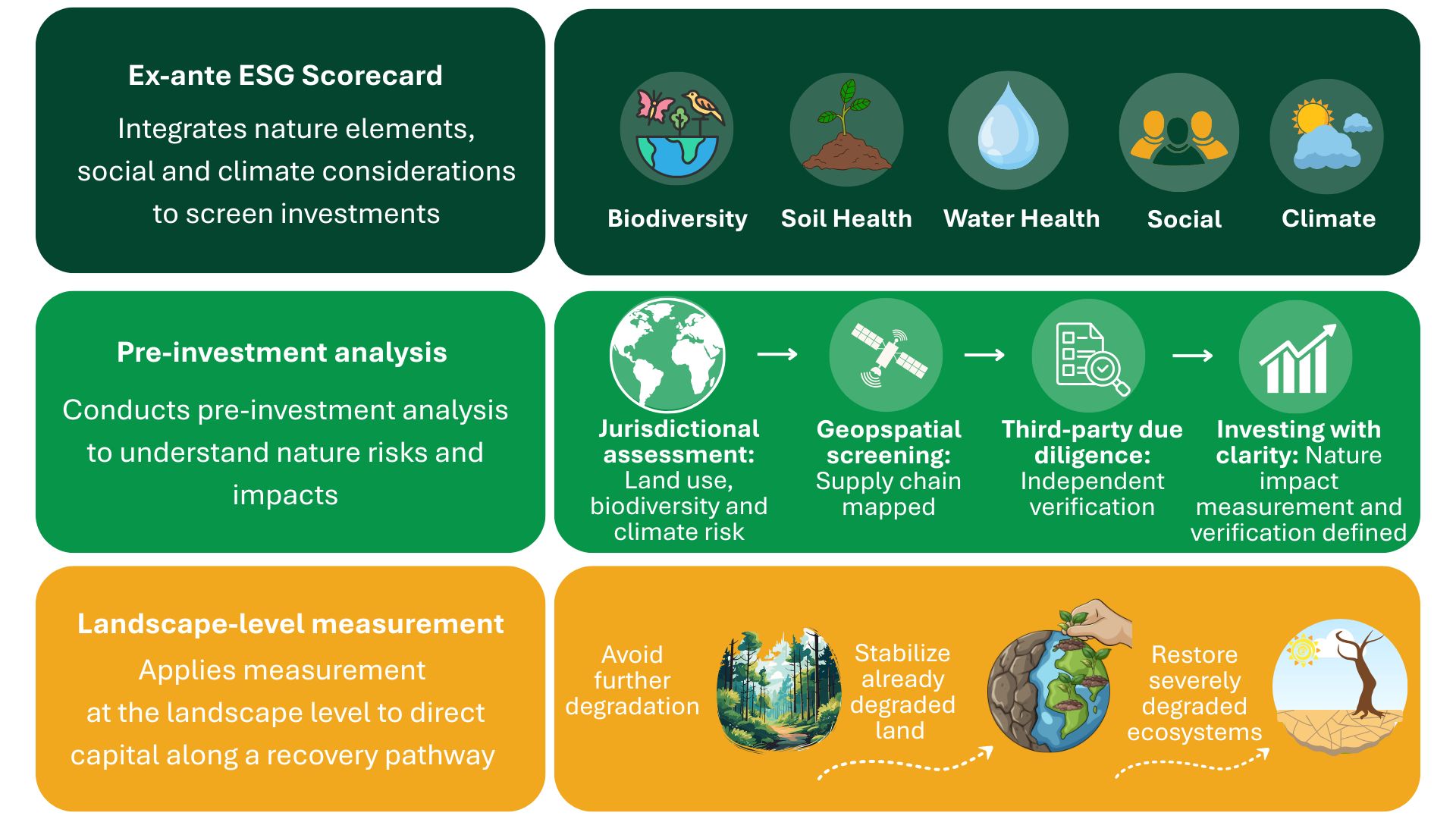
Between them, these approaches embed measurement across screening, underwriting, and portfolio management. Members of our Action Group showed strong interest in developing this further.
Increasing uptake of these approaches requires a more supportive institutional environment. Stronger regulatory and market signals, simpler implementation processes and clearer incentives can help turn emerging practices into mainstream investment approaches. The CLIC Carbon Credit Action Group showed why this balance matters. When payment mechanisms scale ahead of credible measurement, carbon markets experienced unreliable demand, front-loaded costs, low fluctuating prices, and misaligned incentives keep credits stuck as a promising but impractical tool. Nature-linked finance should avoid the opposite problem by ensuring that advances in measurement are matched with mechanisms that create willing buyers and predictable revenue streams.
Making nature outcomes investable requires aligning incentives across the agrifood value chain. Lenders need disclosure requirements that make nature risk material to their own books. Buyers need procurement rules that reward verified sourcing. Farmers need public payments for measured soil and water outcomes on tenors that match a farm’s investment cycle. Our session participants identified the need for both greater regulatory push, such as incentives and disclosure requirements, and market pull, including leadership from large institutional investors.
Nature measurement has improved enough to the point where it is no longer the primary constraint on scaling nature finance. Credible approaches already exist that investors can use to structure deals. The next priority is to develop payment mechanisms that turn measured outcomes into revenue. Agrifood systems offer the clearest near-term opportunity to connect credible measurements with commercial value and durable payment mechanisms. Demonstrating this in practice could provide the proof points needed to accelerate nature-positive finance across other land-use sectors. CLIC will continue working with members to develop the shared frameworks and practical tools to that end.
