


Measuring Access Under the New Collective Quantified Goal: An Implementation Roadmap
Despite increasing total climate finance, persistent structural and systemic barriers constrain access for vulnerable countries. This is particularly challenging for Least Developed Countries (LDCs) and Small Island Developing States (SIDS), where access to finance is critical to driving low-carbon development, strengthening climate resilience, and addressing climate-related losses and damages. These countries face access barriers across the financing chain, from planning and project preparation to approval, disbursement, and reporting. Their challenges include, but are not limited to, capacity gaps; financial, debt, and fiscal constraints; fragmentation of the financial architecture; lack of transparency and predictability; perception and fiduciary concerns; and procedural and administrative barriers. Improving access is, in this way, multidimensional: It concerns not only the amount and terms of finance, but also whether processes are navigable and transparent, and whether countries and local institutions have the capacity and authority to shape, access, and use finance.
The New Collective Quantified Goal (NCQG) on climate finance responds to these challenges by establishing priority interventions for enhanced access. Agreed at COP29, the NCQG, Decision 1/CMA.6, places access at the core of delivery expectations. Paragraphs 21–26 set out expectations for bilateral providers, multilateral climate funds (MCFs), and international financial institutions (IFIs), including multilateral development banks (MDBs), to provide finance—particularly concessional finance—in a timely, predictable, and equitable manner, and to break down barriers that prevent access.
The NCQG establishes a need for systematic reporting on access, but no standardized framework or set of indicators yet exists to measure it, limiting comparability and meaningful reporting. The United Nations Framework Convention on Climate Change (UNFCCC) Standing Committee on Finance (SCF) is mandated to report on collective progress toward all elements of the NCQG biennially from 2028 (UNFCCC, 2024a, para. 30), and Parties have recognized the importance of transparency when measuring progress in enhancing access to climate finance (UNFCCC, 2024a, para. 33). In addition, Parties also agreed that the Conference of the Parties serving as the meeting of the Parties to the Paris Agreement (CMA) will undertake a special assessment of access to climate finance in 2030 with a view to assessing progress on the access-related provisions of the decision and identifying further opportunities to enhance access to climate finance (UNFCCC, 2024a, para. 34).
This Concept Paper, commissioned by the Center for Access to Climate Finance, hosted by the NDC Partnership Support Unit, and prepared by the Climate Policy Initiative (CPI), provides an independent technical contribution to inform this future work. It proposes an Implementation Roadmap to define and measure access enhancements under the NCQG. It is intended as a starting point that the SCF, Parties, finance providers, and recipient countries can consider, refine, and operationalize in tracking access.
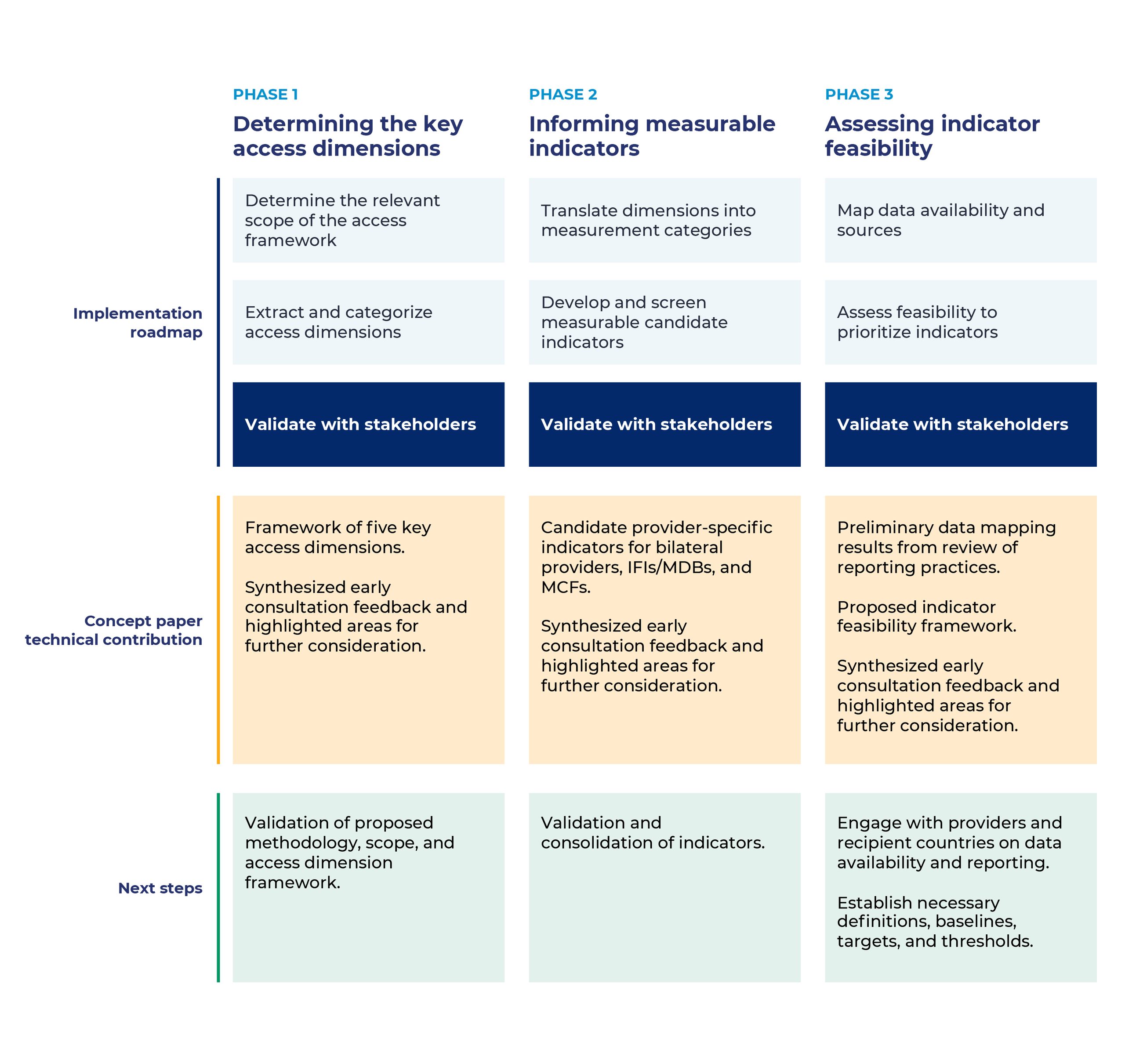
The Implementation Roadmap is the three-phase process through which access indicators can be defined, refined, and tested (see Figure 1). Each phase is consultative and iterative, and feedback at any stage may surface a need to revise earlier definitions, dimensions, or indicators before proceeding. The Concept Paper makes a first application of the Implementation Roadmap, producing provisional access dimensions, actor-specific candidate indicators with indicator passports, and a preliminary feasibility mapping.
The results have been informed by consultations with more than 30 institutions, among them bilateral providers, IFIs including MDBs, MCFs, recipient-country representatives, and technical experts, through bilateral and group interviews, technical workshops, a presentation at the 39th meeting of the SCF, and rounds of written feedback.
Figure 1: Implementation Roadmap
The Implementation Roadmap is offered as a starting point, or proof of concept, that Parties can refine, iterate, and carry forward, rather than a fixed or final indicator set or measurement framework for NCQG access reporting. Outcomes from how the Concept Paper applies the Implementation Roadmap include:
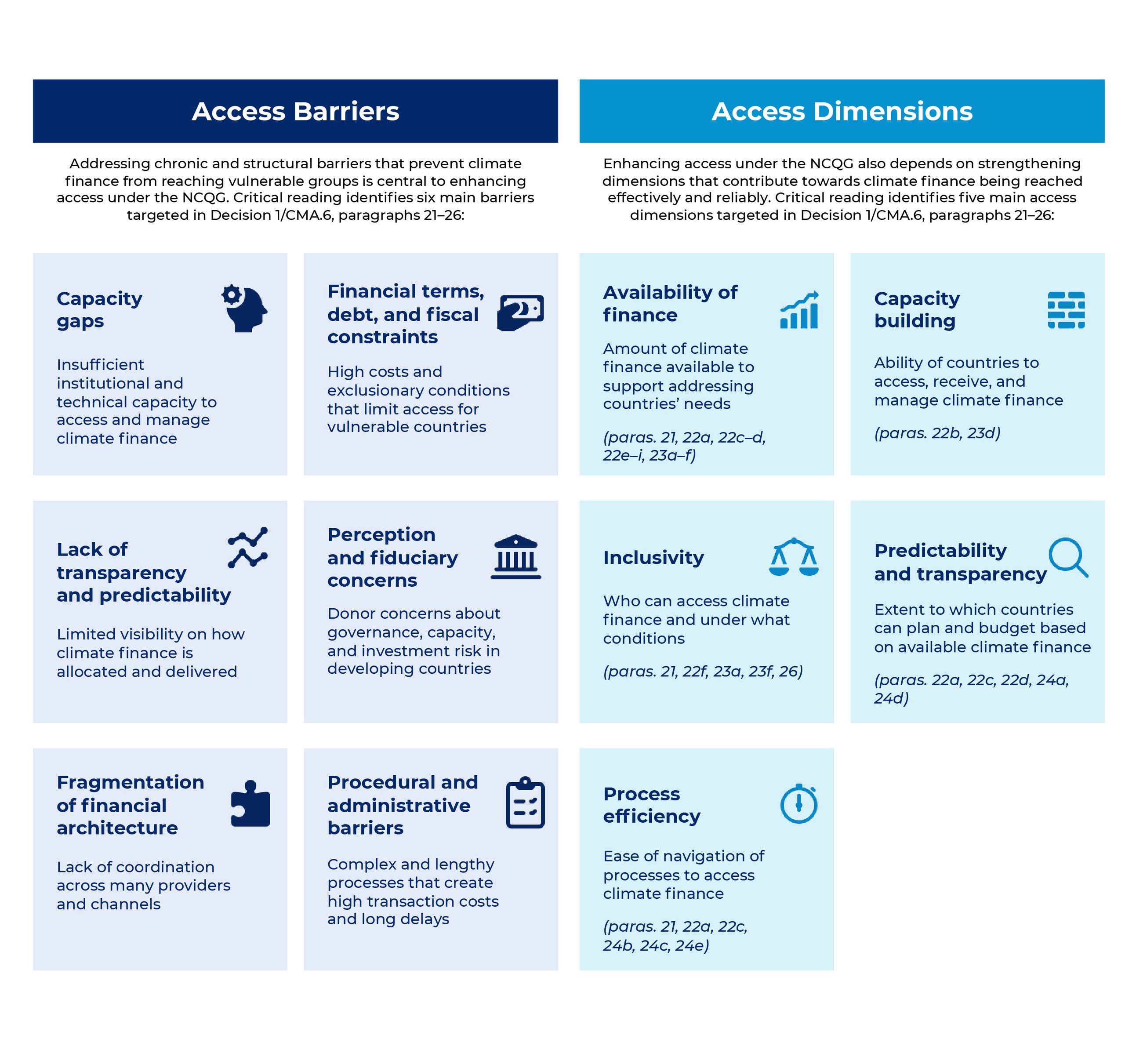
› Phase 1: Determining the key access dimensions. The analysis identified six specific barriers to access acknowledged in the NCQG, and five underlying access dimensions the decision establishes to address them (see Figure 2). Together, these translate the NCQG provisions into areas that can be assessed through measurable indicators, linking the institutional conditions, processes, and modalities addressed in the decision text to potential measures of enhanced access. The dimensions are interlinked rather than mutually exclusive: Several principles in the decision—such as country ownership, direct access, and programmatic approaches—cut across more than one dimension and are captured through relevant indicators under each.
› Phase 2: Informing measurable indicators. Actor-specific candidate indicators were developed for bilateral providers, IFIs including MDBs, and MCFs, recognizing that each group operates under materially different mandates, governance arrangements, and reporting systems. Each relevant provision was first broken down into discrete measurement categories anchored in the Phase 1 access dimensions, and one or more candidate indicators were proposed for each. Each candidate indicator was assessed for specificity, relevance, comparability, and the risk of unintended effects. This screening drew on established indicator-quality criteria such as the Clear, Relevant, Economic, Adequate, Monitorable (CREAM) framework. Indicators were then refined, combined, or removed considering stakeholder feedback. Each candidate indicator is documented in an indicator passport (available in the annex of the forthcoming full Concept Paper) that sets out its definition, unit, calculation method, disaggregation, data source, and interpretation notes to support consistent interpretation across providers. In total, the Concept Paper proposes 32 candidate indicators (13 for bilateral providers, 9 for IFIs including MDBs, and 10 for MCFs) as a starting point for further review and refinement.
› Phase 3: Assessing indicator feasibility. To ground the proposed indicator set in reporting reality, the Concept Paper conducts a preliminary data mapping exercise across a sample of providers—drawing on annual, sustainability, impact, and evaluation reports, project-level databases, and aggregated sources—to assess, indicator by indicator, whether the necessary data are currently reported, partly reported, or not reported, and, where gaps exist, whether that data could realistically be derived.
While the results are preliminary and require further validation with individual institutions, the mapping reveals some broad patterns on data availability. In particular, finance volume data are most readily available, though often not disaggregated at the level indicators require. Additionally, data on providers’ own processes are rarely published but likely held internally. Recipient-side measures, such as application burden and capacity outcomes, would largely require new data collection. The mapping also helps distinguish gaps that could close with improved disclosure versus those that first require common definitions or methodologies, a distinction that can inform a phased approach to reporting.
This analysis focuses on access-related provisions in NCQG paragraphs 21–26, particularly the actor-specific paragraphs 22–24 addressed to bilateral providers, IFIs including MDBs, and MCFs. The candidate indicators are therefore provider focused: They capture institutional and procedural dimensions of access. System-level determinants, including the cost of capital referred to in paragraph 21, debt sustainability, and recipient-country macroeconomic conditions, also shape access but cannot be attributed to individual providers and require complementary analysis. Findings should therefore be read as an assessment of how providers can deliver on and measure their NCQG access commitments, not a complete assessment of any country’s ability to access and use climate finance.
Figure 2: Barriers to Access and Access Dimensions Highlighted in the NCQG
The Concept Paper, which provides the full analytical framework, indicator passports, and Implementation Roadmap underlying this assessment, is available on request. Interested stakeholders may obtain a copy by contacting supportunit@ndcpartnership.org.
