


The Water Resilience Debt Platform: A New Model for Catalyzing Investment
The USD 5.6 Billion Annual Funding Gap for Water
Water insecurity not only threatens human health but is also a growing macro-critical risk to markets across the globe. According to the OECD, economic risks from declining water availability and quality carry a cost equivalent of 7-9% of global GDP, jeopardizing development objectives and livelihoods alike. Nowhere is this more acute than in South Africa.
South Africa is one of the most water-stressed countries in the world, where Cape Town came perilously close to “Day Zero” in 2018. To confront this threat, South Africa needs significant investment in the water sector, with the Development Bank of Southern Africa estimating a daunting funding gap of roughly USD 5.6 billion (ZAR 91 billion) per year through 2050.
Yet, the traditional approach of financing water infrastructure through municipal utilities is failing. Chronic mismanagement, high levels of non-revenue water, and weak governance have left 76% of South African water utilities in financial distress and largely unbankable. Limited fiscal space within public budgets has further stalled the investment that water infrastructure so urgently needs.
An alternative approach to financing is needed.
A New Financing Model
The Water Resilience Debt Platform model addresses this need. Developed[i] by Climate Policy Initiative (CPI) in collaboration with the Resilient Water Accelerator and FinDev Canada, the Platform model is an innovative financing structure designed to mobilize institutional capital for water treatment and delivery infrastructure in emerging economies.
Rather than routing investment through struggling municipal utilities that are often unable to access commercial capital, the Platform model finances on-site industrial water infrastructure through creditworthy private counterparties that are better suited to repayable finance. This creates a bankable investment pathway for capital markets in contexts where municipal utilities are otherwise not readily viable borrowers.
Building on this more creditworthy entry point, the Platform model combines credit enhancement mechanisms with a blended finance approach to reduce the effective cost of capital for project developers, standardize deployment, and crowd in new sources of capital to the sector. The structure is intentionally modular, allowing for different capital stacks and credit enhancement mechanisms to accommodate varying market contexts.
Driving Systems Resilience
The Platform model delivers impact through its ability to help companies mitigate water-related business risks. By financing on-site infrastructure such as wastewater reuse and desalination, the model lessens companies’ reliance on strained public water systems, thereby reducing their long-term exposure to supply disruptions and securing more predictable pricing through offtake agreements.
At the same time, it generates net water gains that expand regional supply, thereby reducing pressure on stressed basins and strengthening climate resilience for local communities and the broader economy. It achieves this by financing infrastructure that creates additional usable water resources within water-scarce basins, including through wastewater reuse and desalination technologies.
The Platform model is already beginning to reshape what is possible in the water investment landscape. In South Africa, a leading commercial bank has adopted the model and is advancing it toward public launch, supported by a robust pipeline of finance-ready water projects. This marks an important proof point for the Platform’s ability to create a bankable pathway for new capital to enter the water sector at scale.
Leveraging Innovations in Finance
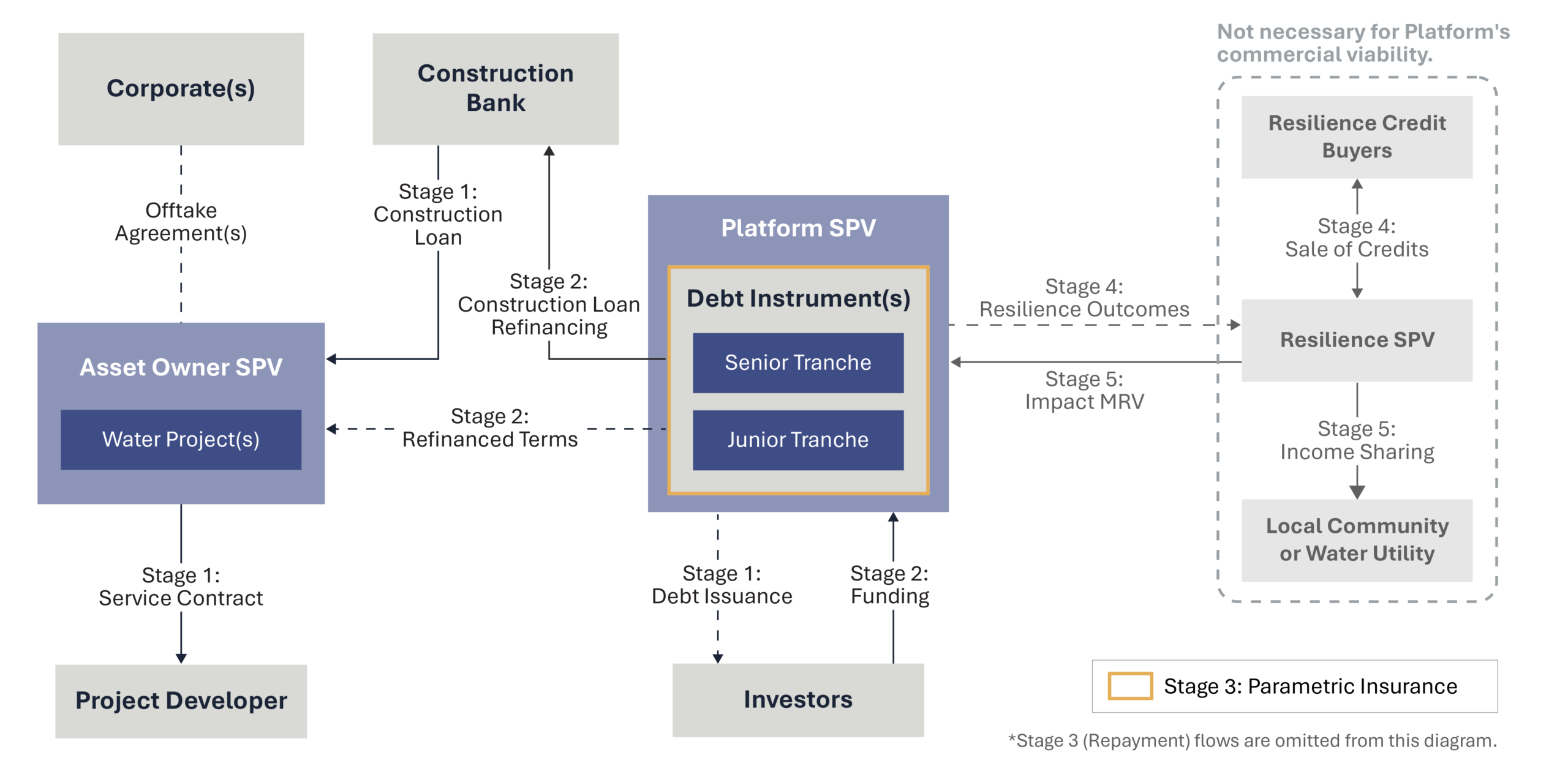
At its core, the Platform model is a standardized multi-phase financing structure that lowers the cost of capital for project developers while aligning the risk-return profile of investments with the distinct appetites of local private capital markets. The structure rests on five stages:
Initiation: A large industrial water user seeks to develop a water project (e.g., a wastewater reuse facility) financed by the Water Resilience Debt Platform. An Asset Owner SPV is established to own the project, held by either the industrial user or investor-developer, with a required 20-30% equity investment in the asset.
Stage 1: The Asset Owner SPV typically contracts a developer to design, build, and operate the project. Construction is financed by a commercial bank, contingent on refinancing through the Platform at the commercial operation date (COD) of the asset. The debt refinancing occurs through the Platform SPV, backed by contractual funding commitments from investors effective at COD.
Stage 2: Upon COD, the project meets the Platform’s contractual funding trigger. The debt refinancing instrument (e.g., bonds, notes, or securitized loans) is funded through the local debt capital market, and the proceeds are used to refinance the construction loan under pre-agreed terms (e.g., 150 bps + consumer price index).
Stage 3: Refinanced loan and debt repayments to investors begin. Revenues are generated through an offtake agreement between the industrial user(s) and the Asset Owner SPV. Parametric insurance coverage of the debt interest payments begins, de-risking against weather-related disasters that could impair revenue generation under the offtake agreement.
Stage 4**: A separate Resilience SPV verifies the project’s resilience outcomes and issues high-integrity resilience creditsii to buyers.
Stage 5**: Revenues from resilience credit sales are used to enhance impact monitoring and verification, thereby unlocking impact-oriented capital that further de-risks the structure and creates additionality. Proceeds can also be directed to local communities or water utilities.
**Resilience credits are not necessary for the commercial success of the Platform.
Industrial Demand as the Entry Point
The Platform’s initial project pipeline is on-site industrial infrastructure, targeting corporates that operate in water-scarce environments where utility supply is unreliable and unaffordable. For these companies, dependence on strained public supply is a mounting business risk, and the Platform model offers streamlined financing for a reliable alternative.
The clearest drawback is that this approach risks diverting revenue away from utilities, as companies turn to their own water supplies. The concern is real, but it can be managed. Industrial facilities can be structured to return a portion of their treated water to utility systems, and the Platform model’s financing structure can eventually be turned toward municipal infrastructure directly, which may require additional de-risking, such as a guarantee for the offtake agreement.
The goal is to prove the model first with the most commercially viable partners, establishing a track record before moving into harder contexts. Ultimately, the model relieves the pressure that large industrial users place on public supply while drawing fresh capital into the sector as a whole.
Replicating and Adapting the Platform Model
The early adoption of the model in South Africa, paired with strong market interest across emerging economies, points to a clear opportunity to scale the model. Two paths stand out.
The first is replication. The model can be replicated in other high-potential markets that share three features: deep local debt capital markets, significant industrial water demand, and constrained public utility supply. Early priority countries include Mexico, India, Indonesia, Bangladesh, Egypt, Malaysia, Morocco, and Thailand.
The second is adaptation. The model can be adapted to finance water utility infrastructure, with an initial focus on “partially bankable” utilities, those that recover a meaningful share of their operating costs but remain unable to access commercial finance at scale. Early markets under consideration include Bolivia, Kenya, the Philippines, Viet Nam, and Zambia.
Whether through replication or adaptation, the reach of the Platform model can extend well beyond South Africa. With the potential to draw billions in new finance into a sector that has long struggled to attract it, the model offers a way to close the water funding gap while strengthening national climate resilience across emerging markets.
Authors: William Wallock (CPI), with key contributions from Sumaiya Sajjad (FinDev Canada)
[i]The Water Resilience Debt Platform model is a Resilient Water Accelerator (RWA) initiative that CPI was contracted to design and launch. Follow-on funding from FinDev Canada subsequently supported CPI in the Platform’s development. The Platform’s structure borrows from Climate Adaptation Notes, a concept endorsed by the Global Innovation Lab for Climate Finance in 2020 that ultimately failed to materialize due to a constrained public pipeline.
[ii]A Water Resilience Credit (WRC) is a verifiable, non-transferable environmental asset representing a quantifiable volume of water saved or treated within a specific geographical and hydrological boundary. It is a nascent environmental credit and is not necessary for the commercial viability of the Water Resilience Debt Platform. Further detail on WRCs can be provided upon request but is beyond the scope of this blog.
